Forget the Forgetting Curve
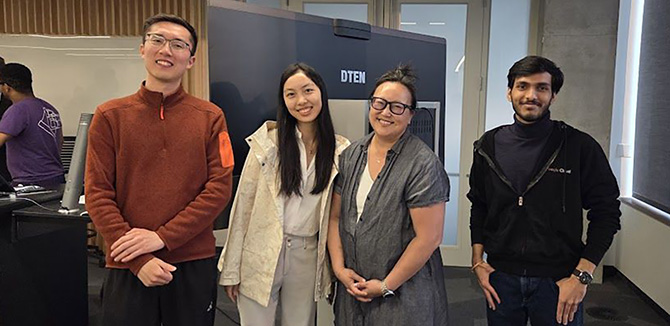
MSAI students Ailin Chu (MSAI '25), Datthesh Shenoy (MSAI '25), and Qixuan Wang (MSAI '25) partnered with Medill associate professor Carolyn Tang Kmet on an AI model designed to enhance recall of lecture information.
A dynamic and engaging teacher stands before a class and delivers a vibrant lesson her well-intentioned students are eager to learn.
Even in this best-case scenario, approximately half of what that teacher taught will be forgotten within an hour, according to a popular educational theory called the forgetting curve. Within 24 hours, nearly three quarters of the lesson will not be remembered. A week later, it will be as if 90 percent of what was taught was never uttered.
Three students in Northwestern Engineering's Master of Science in Artificial Intelligence (MSAI) program are trying to break this forgetting curve and promote greater retention and understanding, with AI as their assistant.
Ailin Chu (MSAI '25), Datthesh Shenoy (MSAI '25), and Qixuan Wang (MSAI '25) partnered with Carolyn Tang Kmet, an associate professor who teaches data storytelling at the Medill School of Journalism, Media, Integrated Marketing Communications, for their MSAI practicum project. The students developed ReMindAI, an AI-powered system designed to enhance learning by making it easier for students to recall and access course content.
“The traditional teacher-student relationship is evolving,” Chu said. “For students, the future lies in using AI tools to enhance their learning and engage with knowledge more effectively. For teachers, it’s about integrating AI in ways that support and elevate their teaching.”
Far from an AI takeover of education, the model the MSAI students developed uses technology to augment the learning process.
ReMindAI allows instructors to upload course materials such as slides, notes, and lecture recordings, while students can add their own files. Using natural-language queries, students can prompt the system to deliver contextual, cited responses to their questions in real time. For example a student could ask what the professor said about a certain topic, or the student could ask the system to explain a concept from class drawing from lectures and additional notes.
“In essence, we applied what we learned to help others hold on to what they have learned,” Shenoy said. “The opportunity to reverse the forgetting curve through intelligent recall and personalized retrieval was timely, not as a convenience but as a necessity.”
This comes as higher education in general grapples with the role AI should play in the classroom.
On average, 86 percent of students used AI in 2024, and half used AI writing tools at least once for a school project, according to Digital Education Council. More than two-thirds of approximately 2,000 teachers surveyed by the Walton Family Foundation believe AI tools will be essential for student success in college and professional work.
Read how MSAI director Kristian Hammond thinks AI can transform education.
With students and teachers recognizing the potential for AI in education, it makes sense for both to collaborate on how to effectively integrate the technology in a manner that promotes learning. That was the student team’s mission – and its goal.
“I found the idea of enhancing education through intelligent retrieval and interaction especially meaningful,” Wang said. “I’ve often found myself wishing for better ways to revisit and understand course materials, and this project felt like a chance to actually build that solution for myself and others.”
The result was a tightly integrated system where students interact with academic content in a way that feels natural and empowering.
It also left their faculty partner impressed.
“In just 10 weeks, they built a prototype that could operate almost entirely on the end-user’s machine, minimizing reliance on enterprise platforms," Tang Kmet said. "Their prototype achieved 80 percent alignment between system responses and my own sample answers. What they accomplished in such a short time speaks volumes.”
Those results wouldn’t have been possible without the students’ first two quarters of MSAI experience, the students said. And the practicum itself prepared them for the rest of their time in the MSAI program and beyond.
“The practicum turned abstract learning into something concrete,” Wang said. “It showed me how to go from ‘What can this model do?’ to ‘How can we make this work for users?’ That shift in perspective is essential for any AI professional.”