
99
years of research and education
Northwestern’s Department of Civil Engineering was instituted in 1926.


Is the water safe to drink, or is the air safe to breathe? Should we eat the fish we catch or the crops we grow? Do our living and workspaces pose special threats to our health? Environmental engineers answer these important questions every day. Standing at the threshold between natural environmental systems and human societies, environmental engineers develop and apply scientific and technological knowledge to eliminate or reduce negative environmental effects.
The bachelor of science in environmental engineering takes an interdisciplinary approach to educating the next generation of environmental engineers. Students graduate ready to apply their broad training to rapidly evolving challenges posed in a diverse range of professions, including engineering consulting, industry, medicine, law, government, and education.
Study with world-class faculty members committed to excellence in teaching
Northwestern’s Department of Civil Engineering was instituted in 1926.

Our faculty boasts numerous seven National Academy members and 10 recipients of the Young Investigator Award, the National Science Foundation’s highest honor to outstanding researchers.
by U.S. News & World Report
The basics at-a-glance
Accredited by ABET, the program's four-year curriculum provides students with a sound foundation in environmental engineering principals, and the opportunity to integrate other key areas into their coursework, including basic science, social science, humanities, and public policy.
Students must complete 48 courses, including required courses in mathematics, engineering, and science; core environmental engineering major courses; and four technical electives that may be used to tailor the program to individual interests.
Comprised of two integrated course sequences, Engineering Analysis and Design Thinking and Communication (DTC), our innovative first-year curriculum provides students with the fundamentals of a successful engineering education, and lets them experience real engineering early in their undergraduate careers.
All students are encouraged to participate in unique and forward-looking research. Juniors and seniors may participate in independent research projects under the guidance of a faculty member, often participating on a team with graduate students.

“The CEE program encompassed a diversity of topics and disciplines that gave me a wide-ranging perspective on why and how the environment looks the way it does today.”
Supplement your degree with programs that prepare you for the next step in your education and career.
The minor teaches practical knowledge fundamental to the data science lifecycle. Students gain experience with a variety of data models and techniques used for collecting, cleaning, and analyzing data. They also learn how to glean insights from data through multiple modern computational tools, as well as the ability to think critically about the construction and implications of analysis and models for data-driven decision making.
Through design studio and architectural history courses in addition to technical elective and a professional development seminar series, the minor blends architectural and design principles with state-of-the-art engineering to train students in the creative and analytical skills needed to shape the sustainable built environment of tomorrow.
Transportation and logistics is an inherently interdisciplinary field of study, reaching across disciplines, schools, and departments. This minor equips students with a broad understanding of the economics, engineering, and operations of transportation and logistics systems, as well as the role of public policy.
McCormick’s Combined Bachelor’s/Master’s Program allows undergraduates to pursue a bachelor’s degree (BS/BA) and master’s degree (MS) simultaneously, shortening the time required to earn a master’s degree. Students can pursue a master’s in Civil Engineering or in a different department.
Beyond the classroom
Enhance your education even further through our many opportunities to network and broaden your worldview.
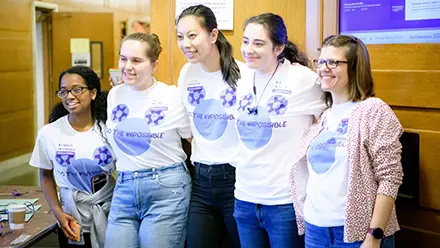
Students choose from numerous student groups including the Environmental Engineering Undergraduate Society (EnvEUS) and Engineers for a Sustainable World.

Northwestern encourages students in all of its undergraduate schools to study abroad. One opportunity that is of particular interest to civil and environmental engineering students is the Climate and Health in South Africa program, where students participate in field-based and interdisciplinary project-based learning.

Our department hosts an annual civil and environmental engineering career fair that attracts companies from wide-ranging industries interested in recruiting students for internships and permanent positions.
Where do we go from here?
Recent graduates hold positions in the public and private sectors as engineering designers, business analysts, and staff engineers of regulatory agencies, including the Environmental Protection Agency. Many of our graduates continue their education in prestigious schools of engineering, law, medicine, public health, and management.
While at Northwestern, our students benefit from professional development opportunities that prepare them for the next step in their careers. They have access to internships and extensive career placement resources via both Northwestern Engineering Career Development and Northwestern Career Advancement.
Where our alumni attend graduate school










Where our alumni work in industry








We encourage you to visit our campus and learn about Northwestern Engineering firsthand.