Compassionate Code
Philip Dawny Philip (MLDS '25) is using his time in MLDS to help build a chatbot that offers cancer patients support at any time of the day.
A cancer diagnosis can lead to a wide range of questions emerging at different times of day.
Philip Dawny Philip (MLDS '25) has been working on helping cancer patients get the trustworthy answers they need — whenever they need them.
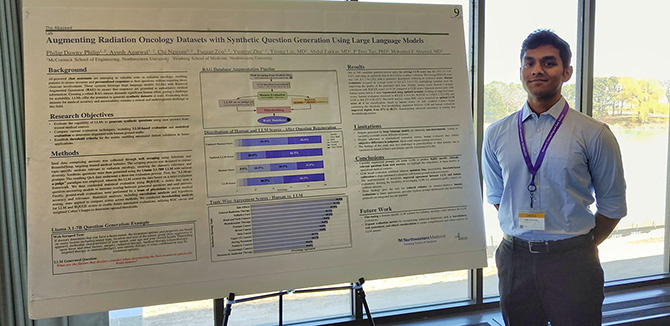
Philip spent eight months working with Northwestern Medicine’s radiation oncology department on his practicum project for Northwestern Engineering’s Master of Science in Machine Learning and Data Science (MLDS) program. The goal was to build a chatbot that could provide meaningful support to patients from the moment their cancer journey begins, and their work has already led to multiple publications. As an extension of that work, Philip will present at the Radiological Society of North America Conference in Chicago, and he and his team submitted additional abstracts to medical journals, including Nature Medicine.
“This isn’t a medical chatbot,” Philip said. “It doesn’t provide treatment recommendations but serves as a supportive assistant that answers questions and directs patients to reliable resources.”
The chatbot uses large language models (LLMs) combined with retrieval-augmented generation (RAG) to ensure responses are grounded in verified clinical guidelines. Patients can ask about side effects, preparation, or treatment processes — and receive answers anytime, including evenings and weekends
This comes at a time when AI-driven chatbots are gaining patient favor. A Journal of the American Medical Association (JAMA) Network Open study found that patients preferred chatbot responses over physician responses in 78.6 percent of answers to randomly selected questions. The respondents said the AI-generated answers were more empathetic in a majority of the cases.
Philip and his teammates – Chi Nguyen (MLDS '25), Jerry Zhu (MLDS '25), and Fuqian Zou (MLDS '25) – used synthetic patient queries to test the chatbot’s ability to handle patient questions while preserving privacy. They deployed the model on Amazon Web Services and performed rigorous statistical and robustness analyses to validate its performance.
The project wasn’t just technical; it was deeply collaborative. The student team worked with doctors, radiation scientists, technicians, and other medical personnel. These domain experts were well-versed in the medical side of the project, but their lack of deep generative AI knowledge tested Philip’s MLDS-driven ability to communicate technological topics to diverse stakeholders.
Troy Teo, an instructor of radiation oncology at Northwestern’s Feinberg School of Medicine, served as the team’s sponsor. An early study by Teo’s Northwestern team, published in JAMA JAMA Network Open, highlighted several limitations of generic LLMs in responding to radiation oncology patient queries. These included challenges such as high readability requirements that can hinder patient understanding. The localized model developed in this project directly addresses these issues, ensuring responses are not only accurate but also accessible and aligned with clinical standards
Teo lauded Philip and his teammates for building a trustworthy AI chatbot to help patients understand the often complex aspects of cancer care.
"Partnering with MLDS students allowed us to leverage their strengths in data science, cloud deployment, and machine learning pipelines — skills essential for building, testing, and validating a system that could one day be deployed in real clinical settings," Teo said. "Their work advanced the broader effort to make large language models in healthcare both trustworthy and clinically aligned, setting the foundation for future AI tools that can assist patients."
Following a summer internship at Nokia, Philip is continuing to support Teo and the cancer chatbot for his Capstone project.
It is that type of hands-on experience that made the MLDS program stand out to Philip as he considered master's programs.
"Right when you land in the program from the first quarter onward, you're working with a practicum company," he said. "MLDS stood apart from all the other programs because of how much industry exposure you get in the program."