

Hartmann Charts a Future of Growth and Discovery for Biomedical Engineering
Professor Mitra Hartmann steps into the role of BME chair, outlining priorities for growth, interdisciplinary research, and emerging health-transforming technologies.
Biomedical engineering is evolving rapidly through advances in bioinstrumentation, data-driven modeling, and precision therapeutics—and Professor Mitra Hartmann, the new chair of Northwestern’s Department of Biomedical Engineering, is positioning the department to lead in these and other emerging areas.
“In the coming years, biomedical engineering will be transformed by technologies that allow us to observe, simulate, and guide living systems with unprecedented precision. Engineering and biology are converging faster than ever, and our department is helping to shape that future.” Hartmann said. “The pace of change is exciting. Our community is eager to grow while maintaining the collaborative culture at the heart of our research.”
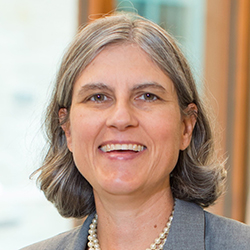
Hartmann, who succeeded Professor Matthew Tresch on September 1, sees the years ahead as an opportunity to continue the momentum Tresch helped create, and to expand the department’s scientific reach and interdisciplinary ties across engineering, medicine, and the life sciences.
In this Q&A, she discusses some of the department’s strategic priorities, emerging research frontiers, and cross-campus partnerships that will define the department’s next chapter.
What is your vision for the future of the department, and how do you plan to build on its existing strengths?
Northwestern’s BME faculty embody ambition, collaboration, and genuine collegiality. Rather than a “vision” for the future, I see a clear imperative: to grow the department in a way that matches the scale of our ambition, while preserving the exceptional culture that defines us. My goal is to expand our research and educational footprint strategically and sustainably, without losing the friendliness, openness, and deep collaborative spirit that make this department such an energizing place to work and learn. We are already recognized for leadership in a broad range of fields, including regenerative engineering, bioelectronics, and biomedical device innovation. I see the department building on this foundation by scaling into areas poised to transform human health. Those areas include creating next-generation imaging and sensing technologies for early disease detection, developing tools to probe and manipulate cellular and molecular processes with greater precision, engineering ways to restore or replace lost tissue function, and advancing bioelectronic systems that can communicate directly with the nervous system. My vision is for a department that expands its size and impact while remaining collaborative, inventive, and eager to cross boundaries, ensuring that our basic science discoveries and engineering innovations together advance human health.
How do you hope to enhance the experience for BME students—both in terms of research opportunities and preparation for careers in academia, industry, or medicine?
Students are most successful when they have the freedom to explore big questions while being supported by a community that believes in their potential. I want every BME student to feel that sense of possibility. One priority is to broaden access to research experiences, both within the classroom as well as through summer and academic research fellowships in industry and in individual laboratories. Expanding collaborations with the Feinberg School of Medicine will open new pathways for students interested in clinical translation, rehabilitation science, and device development. Strengthening connections with industry partners will help students gain hands-on experience in regulatory science, product design, and entrepreneurship. Equally important is preparing students for the diversity of careers they may pursue. Whether a student aims for a career in academia, biotech, or medicine, we want to provide structured mentorship, targeted professional development, and a curriculum that builds both analytical rigor and creative, hands-on problem-solving skills. The goal is for every student to leave our department with the confidence and technical capability to lead in whatever direction they choose.
Which emerging areas of research or technology do you think will define the field in the near future?
Biomedical engineering will be shaped by technologies that let us measure, model, and manipulate biology with increasing precision. AI-driven methods are already transforming how we analyze complex biological data, revealing patterns that can accelerate both basic discovery and therapeutic design. Next-generation drug-delivery strategies are poised to reshape how pharmaceuticals are formulated and delivered, increasing treatment precision and reducing unintended side effects. At the same time, advanced in vitro systems such as organoids are giving us new ways to study human biology that complement insights from animal models. Equally important are the tools that let us query biological systems more deeply: ultra-sensitive sensors, imaging platforms with high spatiotemporal resolution, and new approaches for tracking cellular behavior in real time. Together, these capabilities suggest a future where we can study biological systems with better clarity, and act on that knowledge more precisely.
In parallel with these advances, we will need to think carefully about the ethical dimensions of the technologies we create, from data privacy and algorithmic fairness to questions raised by emerging biological models. These considerations also include ensuring that the benefits of biomedical technologies reach the full range of communities they are meant to help. Building these principles into the design and deployment of new technologies will be essential to earning public trust.
How do you see interdisciplinary research shaping the next decade of biomedical engineering?
Biomedical engineering has interdisciplinary qualities built into its name: biology, medicine, and engineering. The next decade will make that integration even more essential. Many of the most important problems in human health sit at boundaries, whether between biology and computation, medicine and materials science, or engineering and global health. Progress depends on teams that can cross these boundaries fluidly and bring together ideas and tools that no single field could provide. Northwestern’s BME community is already structured for this kind of convergence. Our faculty lead an interconnected set of institutes and centers that bring together engineers, scientists, clinicians, and partners across campus and around the world, creating an environment in which interdisciplinary work is fundamental to our research identity. These collaborations ensure that our students learn to think across disciplines rather than within them and help us design technologies that are shaped both by scientific insight as well as the practical needs of patients and communities.
What excites you most about stepping into this leadership role, and what lessons from your own research career do you hope to bring to the position?
This role offers a direct view into the extraordinary work that BME faculty are doing. It makes me feel part of a long tradition in which science advances through debate, self-correction, and shared discovery. Passing that sense of joy and collective purpose to the next generation is a privilege.
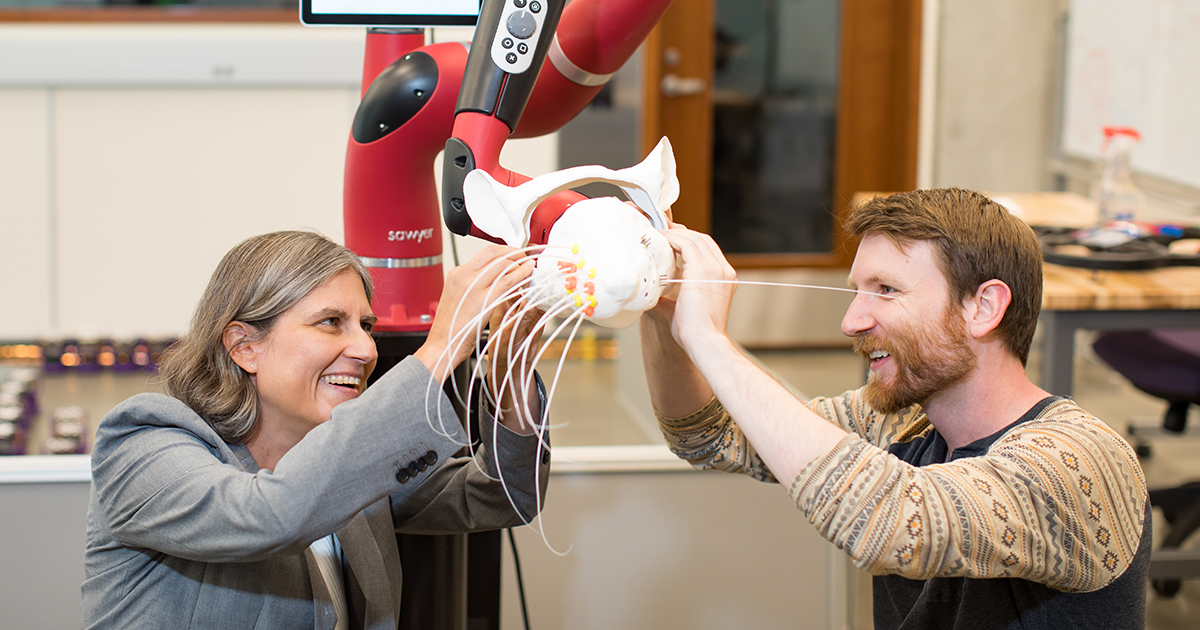
In my own research, I study how sensing, movement, and expectation shape one another – how an animal’s experience of the world depends on how it explores and what it anticipates. I’ve always seen a parallel in how science and engineering move forward: progress hinges on the questions we choose to ask and on remaining open to unexpected results. Many of the most meaningful insights in my career have emerged from collaborations that seemed unlikely at first or from ideas that challenged familiar assumptions. This perspective has shown me how essential it is to build a culture that pairs rigorous inquiry with intellectual risk-taking. Stepping into this role gives me the opportunity to help cultivate those values on a broader scale.
How do you plan to build on the foundation Matthew Tresch established as Chair, and what aspects of his tenure do you most hope to continue or expand?
Stepping into this role feels far easier thanks to the strong foundation Matt built for the department. Matt has been a steady, thoughtful leader who encouraged collaboration across campuses, helped recruit terrific new faculty, and created an atmosphere where people genuinely enjoy working together. My aim is to retain the open and collaborative spirit he helped foster while bringing the department into its next stage of growth. Thanks to Matt, we’re starting from a place of real strength. That gives us room to think big.