

Student ProjectsNUSTARS Rocket Team (2026-2027)
Project Manager
Max Hughes
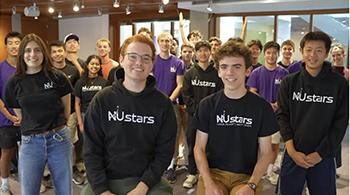
Northwestern University Space Technology and Rocketry Society (NUSTARS)
Amount Requested
$5,000
Summary
In the last academic year, NUSTARS Rocketry competed in the International Rocket Engineering Competition (IREC) for the first time. IREC is the largest rocketry engineering competition in the world, where over 140+ teams compete to build launch vehicles capable of flying to 45,000’ and scientific experiment payloads. Now that NUSTARS has completed its first year in IREC with a simpler design, the team wants to expand our engineering to take advantage of the full design capabilities enabled by the competition.
For the 2027 IREC, NUSTARS will engineer a rocket and payload throughout the next academic year to compete in the 10,000’ apogee category. The team plans to investigate two primary projects that will greatly advance launch vehicle performance through the development of this rocket: novel researched and developed composite carbon fiber structure components and a custom flight computer. In addition to increasing our competition performance by reducing mass, developing in-house composite manufacturing techniques will prepare members for their prevalence in aerospace careers. Developing an in-house flight computer will teach members invaluable skills in designing redundant flight electronics and in-flight active control systems. Both of these projects will require prototyping, manufacturing, and extensive ground testing to properly characterize and iterate our systems.
Beyond the launch vehicle, NUSTARS will be designing and building a new payload. This will be a student-led project, with an objective chosen by the team. We will participate in the IREC SDL Payload Challenge, involving a CubeSat form factor payload. Each year, the rocket's payload gives us an opportunity to push our engineering capabilities, from mechanical design to software development. In past years, we have tackled challenges from a deployable glider to an automated airbrake system, giving the members a unique experience tackling diverse real-world engineering problems. The team requires specialized material stock, electrical components, and tooling for the unique aspects of each payload.
Once the launch vehicle and payload systems are designed and assembled, several launches will take place, which provide design validation and key data for further iterations before competition. For each flight test of the rocket and internal systems, the team travels to a nearby launch site in Wisconsin, Illinois, Indiana, or Michigan. For each flight test milestone, we require car rentals and single-use equipment such as the rocket motor.
We also plan to share our work and cultivate interest in engineering within the larger Evanston community through our outreach and STEM engagement programs with local schools and groups. These initiatives involve purchasing and building lower motor class rockets with individual students from our partnered schools, through guided workshops and in-person sessions with NUSTARS members.
With the Murphy grant funding, NUSTARS rocketry will be able to develop a new rocket, design an innovative payload, and create valuable launch experiences for all our members. These efforts will continue NUSTARS’ position as the premier aerospace organization at Northwestern that prepares students for careers in aerospace engineering.
Planned Activities/Investments
Over the summer, students will be identifying engineering focuses that they are interested in learning about for the various subteams -launch vehicle, payload mechanical, and payload electrical- and defining projects and possible payload challenges to take on.
During the fall quarter, the team starts by focusing on setting design requirements and doing failure modes and effects analysis (FMEA). Students will then start prototyping and testing concepts. Students prepare and deliver a preliminary design review for their respective projects. After the PDR, students refine their design and present a critical design review to communicate manufacturing intentions and plans.
The winter quarter focuses largely on manufacturing and testing. Students use available machinery and tooling purchased by the team in the CNC mill, CNC lathe, manual mill, and manual lathe for the various relevant projects, as well as the water jet, drill, and filament winder. Students also ensure that the various projects are properly integrated through extensive ground testing. Murphy Society funding would be used throughout this quarter to fund building and testing efforts as outlined in the budget below, allowing the team to design more complex systems than ever before.
In the spring quarter, students will conduct flight tests of the launch vehicle and payload. A first launch will be performed to validate the vehicle’s flight path and stability. After that, the team will validate the payload’s performance within the launch vehicle. At the end of the year, the team invests in student’s aerospace engineering journey by funding personal certification rockets.
In June, the team will travel to the IREC competition in Midland, TX, where we will fly the launch vehicle and payload with 140+ other teams. The team will present our work and compete for a selection of engineering awards.
Impact
NUSTARS Rocketry serves McCormick by helping the school meet the rapidly growing interest in aerospace at Northwestern. It serves as a barrier-free avenue for students in engineering to gain engineering experience working as part of a team on aerospace, electrical, and mechanical engineering projects. This impact will be quantified through membership in NUSTARS and their contributions to the competition rocket. Students who are very engaged in the competition also often continue involvement in aerospace engineering by obtaining their Level 1 and Level 2 high-power rocketry certification. This past year, Rocketry had over 30 active members with 17 constructing certification rockets.
IREC is a unique opportunity for students to learn from and interact with international rocketry teams. Throughout the year, NUSTARS members communicate frequently with other teams via the IREC Discord or read past year’s competition reports, providing rapid learning opportunities through knowledge sharing. At the competition in June, getting to see the engineering of other teams gets students excited about rocketry and helps them brainstorm how to push their engineering further in future years. The number of students who attend the competition is a good indication of students who are engaged and passionate about rocketry and engineering. This past year, 18 students attended the IREC competition.
Finally, the rocket team will directly impact the local middle and high school students at the community organizations it works with in the STEM engagement program. In addition to encouraging interest in aerospace and STEM in general, planned activities with a local Girl Scouts of the USA division will enable the scouts to gain their rocketry patches. This impact will be quantified through how many children participate in the program and the number of rocketry patches awarded. This past year, NUSTARS was able to engage 46 middle and high school students.
Deliverables
There are three key technical deliverables that we plan to produce within the upcoming academic year. First, our IREC launch vehicle, which will be manufactured with a combination of in-house and off-the-shelf components such as body tubes, a nose cone, and the fin system assembly. Next, we will be designing and developing a novel payload that performs a science experiment of our choosing. This past year, the team developed a deployable body which is able to control its orientation during descent using a reaction wheel. Finally, we will meet competition deliverables. These deliverables include 3 milestone progress reports, a Video Flight Readiness Review, and an AIAA conference technical report. Each of the IREC deliverables showcases our engineering analysis, design, simulation, testing, and manufacturing skills.
Sustainability
Although structured around a yearly competition cycle, NUSTARS Rocketry improves upon our engineering every academic year through a continual, iterative process. For example, when competing in the NASA Student Launch in 2025, we developed a 3D-printed fin clamp system. The team took this project to the next level the following year in the IREC 2026 by implementing a fully aluminum fin system that was selected as a podium session finalist (20/140+ teams). The projects funded by the Murphy grant are, therefore, not standalone and culminate across years. The knowledge gained by the team through this year’s project will be passed down and developed in future years. This reinforces engineering and design thinking principles of iterative design and development, much like industry-level practice.
More specifically, on hardware and tools that the team will be able to purchase using the Murphy grant funds, high-quality materials will be valuable in increasing year-to-year manufacturing abilities. Purchasing high-quality tooling for the team is a sustainable measure as it will be able to be used for future year manufacturing efforts. Additionally, designed flight computers can be used for many years, as they are reusable and are shared across the years. To support the purchase of spent goods each year (i.e., construction materials), NUSTARS will pursue funding opportunities through the McCormick Student Advisory Board, Catalyzer, and corporate sponsorships, as the team has in previous years.
Previous Project
Last year, NUSTARS graciously received Murphy Society funding for our newly founded Lunabotics team. With Murphy Society support, NUSTARS was able to develop a functional rover from the ground up that can actuate a shovel to create berms in the sand–just like lunar rovers will create berms on the lunar surface to protect astronauts. While the team was unable to attend their competition in person due to logistical challenges, Lunabotics received an award for Stellar Systems Engineering by a First Year Team from NASA, and will continue rover development next year with the addition of an R&D subteam in charge of designing and running experiments on the vehicle. NUSTARS hopes to continue to rapidly expand our team’s accumulated knowledge, expertise, and deliverables on our Rocketry subteam for the upcoming year.
Budget Overview
- Composites materials: Laminating epoxy, carbon fiber fabric, vacuum bagging materials, $2,400.00
- Flight Computers: Flight computers to control parachute deployments and log high-rate data during flight, $800.00
- Stock: Stock metal for bulkheads, fin clamps, custom payload mechanical parts, $800.00
- Electrical Components: Sensors, custom PCBs, microcontrollers, motors, solder, flux, $950.00
- Tooling: Tools for advanced machining, reducing dependence on Ford shop tooling, $1,800.00
- Rocket Motors: Solid rocket motors used to propel launch vehicle, $2,560.00
- Recovery Hardware: Parachute, shock cord, attachment hardware, $1,000.00
- Travel: Rental cars for flight tests, housing at competition, $6,000.00
- STEM Outreach: Materials for education and build sessions with Evanston and Chicago communities (middle/high schools, Girl Scouts, etc.), $400.00
- Safety Equipment: Gloves, respirator filters, first aid kit, $400.00
- Total: $17,110.00
Total Budget Amount: $17,110
Matching Funds
We do not have any commitments or sources for matching funds. However, we are committed to leveraging additional resources, such as the McCormick Student Advisory Board and Catalyzer, to maximize the impact of any funds awarded by the Murphy Society. NUSTARS is also in the process of maintaining and developing corporate sponsorship opportunities to ensure the long-term sustainability of the NUSTARS rocketry team.
Faculty Adviser/Department
Nick Marchuk/Mechanical Engineering