

Student ProjectsEEG-Controlled Wheelchair
Project Manager
Nathaniel Rogers
Medical Makers
Amount Requested
$4,200
Summary
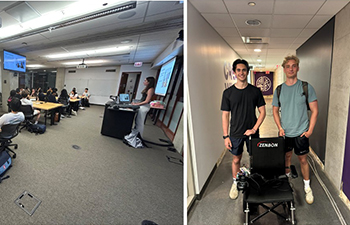
Medical Makers is Northwestern’s largest student group that focuses on the research, design, and engineering of novel medical devices. Each year, we facilitate two engineering projects, one new and one carried over from the year before. This Murphy Grant funding is intended to support both expanded general club operations and the progress of one of the project teams—the EEG Wheelchair team. Our 40+ members on the EEG Wheelchair team, whose majors span from BME, ME, EE, and ChemE, to math, physics, computer science, neuroscience, and biology, work together towards a common goal: build physical products that make real people healthier.
A classic engineering challenge for undergraduate medical device groups like Medical Makers is to improve the mobility of patients with severe motor impairments that prevent them from using joystick-controlled power wheelchairs, without succumbing to the unsanitary alternative of sip-and-puff systems. Medical Makers has tackled this challenge in a commercially promising way by developing a low-cost, non-invasive brainwave (electroencephalography, EEG) interface that enables users to control their existing power wheelchairs using motor imagery control (for example, by imagining lifting their arm). As the EEG Wheelchair project enters its second, and ideally final, year of development, additional funding would significantly enhance its progress and the quality of its final prototype.
Following visits and conversations with patients and healthcare professionals at Shirley Ryan AbilityLab, our partner hospital, the EEG Wheelchair team has begun developing the system that would allow newfound independence for late-stage ALS or quadriplegia patients without heavily modifying their wheelchairs, which they see as an extension of their body.
Currently, the project consists of two working subsystems: an EEG-based motor imaginary intent recognition algorithm and a physical wheelchair control accessory capable of pushing a wheelchair joystick using two compact robotic arms. The team has found early success with both: the software subteam has prepared a machine learning algorithm that recognizes intent with approximately 80% accuracy; in parallel, the hardware subteam has developed a functional prototype of the robotic attachment system, validating its feasibility.
The team has also secured a unique partnership with a research-grade EEG hardware company that has supplied significantly discounted recording equipment and technical guidance throughout the course of the project.
The project has exposed students to real-world interdisciplinary engineering challenges spanning signal processing, applied machine learning, neuroscience, embedded systems, mechatronics, CAD, fabrication, and human-centered medical device design. Members also gain experience that extends far beyond classroom instruction by collaborating with clinicians, interacting with patients, troubleshooting physical prototypes, and iterating on designs in response to real engineering constraints.
With the support of Murphy Grant funding, the EEG Wheelchair team will finalize their attachable control system by integrating the component software and hardware subsystems, collecting additional trial and user data to improve control accuracy and precision, designing and installing easy-to-attach failsafe sensors on a test wheelchair as safety overrides for the EEG system, and investigating the feasibility of a custom EEG or EEG-multimodal headset to improve user experience and data collection consistency.
Planned Activities/Investments
Before explaining the specific activities that will be supported by Murphy Grant funding, we find it important to include Medical Makers’ general operational structure as context for our conscious, efficient usage of the Grant’s financial resources. Fundamentally, Medical Makers is a project club, and the experience of several years operating as such has led to a strong structure for attracting and maintaining participation while advancing our projects. Namely, we will host general meetings at the start of fall and winter quarters, introducing new and returning members to the club and its current projects. Then, each project team (of which there will be two, including the EEG Wheelchair team) will host weekly all-team meetings.
Because weekly meetings tend to be insufficient for complex engineering projects, project teams are typically broken into subteams, which meet outside of all-team meetings according to project needs. This format allows us to run project teams using a Scrum-like project management framework, where teams provide bare-bone updates and exchange information in regular intervals, then spend most of their time doing the engineering and design work that defines our club.
Murphy Grant funding will not be directly used to support these general and weekly project meetings. Instead, funding will be allocated to skill-building activities and workshops, project team prototyping, and the furnishing of a new collaborative workspace for the club.
Medical Makers supports the acquisition of hard skills that students must learn outside of class, like soldering, 3D printing, and breadboarding, by hosting workshops and weekly gamified design activities. Supplies like basic electronics equipment, solder wire, and microcontrollers will be purchased using Murphy Grant funding and used in these workshops.
As a student group, we also encourage failing forward and iterating on prototypes quickly in pursuit of a strong final medical product. To do so, our members travel to and tour Shirley Ryan AbilityLab to meet users and gain a hands-on understanding of the clinical issue they’re addressing. At the end of each quarter, students also present their project progress to real-world industry representatives from Stryker and/or McMaster-Carr through established partnerships with engineers at the companies. Finally, members are supplied with adequate prototyping equipment with which to advance their projects. Again, this equipment and general project materials must be paid for out of resources like the Murphy Grant.
Finally, with our newly granted club-specific workspace, students have the opportunity to access a project workbench 24/7. A significant portion of the Murphy Grant this year will go towards furnishing this space with prototyping tools, like a shared PC, an oscilloscope, basic hand tools, and breadboarding equipment, that allow students to make progress on club projects in a space that feels special to them and contributes to their undergraduate experience.
Impact
Primary Impact: Student Development
This project will provide participating students with hands-on experience in engineering design, interdisciplinary collaboration, and medical technology. Students will develop technical experience with CAD, electronics, programming, 3D printing, data processing, and prototyping. The breadth of skills developed by each student will depend on their subteam, which facilitates the improvement of students' technical communication skills and interdisciplinary collaboration. In addition, students will learn best practices of iterative product development and will gain familiarity with the field of medical technology through well-documented research. Students will also develop their professional skills through design reviews, presentations, and correspondence with Shirley Ryan AbilityLab. Overall, this project will not only expand on engineering coursework but also provide students with technical and professional know-how only found beyond the classroom.
The educational impact will be assessed through student feedback surveys aimed at gauging the development of technical, professional, and communicative skills. The Medical Makers Executive Board will review students’ responses to evaluate the project's contribution to student development.
Patient Impact: Wheelchair Users with Limited Upper Body Mobility
Our EEG-controlled powered wheelchair aims to improve accessibility and autonomy for powered wheelchair users, primarily those with restricted upper body mobility who may have difficulty with conventional control interfaces. By reducing the need for fine motor skills, the EEG control system will enable comfortable, independent, and accurate navigation without compromising reliability or ease of use. Additionally, the modularity and cost of our design will expand accessibility and allow the EEG system to benefit a diverse group of powered wheelchair users.
We will evaluate the primary impact of our design by working closely with clinicians and patients at Shirley Ryan AbilityLab and through user testing. Functional user testing will focus on measuring movement speed, navigation accuracy, and task completion time, while feedback surveys for both clinicians and users will capture key metrics and experiences such as ease of use, comfort, and overall satisfaction.
Deliverables
Primary Deliverable:
The end goal of this project is a device that can be integrated with a joystick-controlled wheelchair. Our primary deliverable will be at least one functional EEG-controlled wheelchair prototype, including a custom EEG headset and joystick control mechanism. This prototype will be fully prepared for clinical testing.
Documentation Package:
-
CAD renderings and detailed engineering drawings
-
Comprehensive design rationale documentation, outlining design requirements
-
Explicit instructions for installation and operation of the system
Assessment Tools:
-
User feedback survey: Evaluation of participant comfort and overall satisfaction with the prototype
-
Clinician feedback survey: Assessment of clinical impact, patient usability, and further medical or safety considerations
-
Functional testing: Verification of classification accuracy and successful obstacle navigation
Competition Portfolio:
-
A complete portfolio that is ready for submission to engineering design competitions such as the Medtronic/BMES Student Design Competition, RESNA, or DEBUT and includes project documentation, details of the design process, and supporting visual materials, with the opportunity to earn national recognition and cash prizes
Sustainability
Medical Makers prioritizes member retention through a range of club activities consisting of seasonal events, weekly project meetings, and end-of-quarter design reviews. This leads to an organization that is not only productive in designing medical devices, but also fosters a welcoming environment and community. This combination encourages Medical Makers members to participate in the organization throughout their time at Northwestern University, usually lasting 3-4 years, depending on when they join. The funding from the Murphy Society will not only advance the EEG-Controlled Wheelchair project, but will also serve as a lasting investment in sustaining this welcoming environment and ensuring continued impact through the upcoming years as members continue to participate.
Previous Projects
This past academic year, we received funding from the Murphy Society to advance our Active Slide Board project. Through communication with nurses at Shirley Ryan AbilityLab (SRAL), it was understood that there was a current need for a device to assist patients with limited lower mobility in transferring from a wheelchair to a bed and vice versa. The status quo of a slide board is a rather simple design of a wooden or plastic board that the user moves across. Difficulties occur for independent movement across the board when this transfer has to occur at an incline.
In order to reduce the strain that patients and nurses experience during such processes, Medical Makers designed an electromechanical device. The device consists of an aluminum frame surrounding a conveyor-belt-like system. This belt system will rotate due to a motor-gear system providing the necessary torque to transport the patient across.
The fall quarter of the 2025-2026 academic year focused on confirming the above design. The beginning of the quarter focused on gaining a better understanding of the problems at hand and plausible ways to resolve them. Various design workshops in project meetings were completed until a transition towards mock-up construction happened to produce a physical model of our conceptual ideas. This took place for the last couple of weeks of the quarter until the most beneficial aspect of this past year occurred: the end-of-quarter design reviews. Through communication with industry professionals, the design reviews consisted of an approximate 15-minute presentation from the project team highlighting the work completed over the past quarter, which was then followed by a 45-minute conversation with the professionals. Additionally, before the review occurred, a design review brief was written by the project team and sent to the reviewers to ensure that they had the necessary information to provide optimal advice for improving the device. Through these design reviews, the project team was able to know the best way to move forward with the project.
Taking into account the feedback received, the winter quarter consisted of a transition to producing a model that could prove the design mechanism would work on a scaled basis. This proof-of-function mock-up was constructed of a laser-cut wooden frame, stepper motor, Elegoo Uno R3, chain, sprocket, rollers, and belt material. The model was successful in proving that the current design would work in allowing for the movement of the belt system, allowing us to move towards a to-scale prototype design the following quarter.
Before this transition occurred, feedback from the design review was again critical, with a focus on ease of assembly. As such, an emphasis was placed on a CAD model that allowed us to focus on components of the design that could be made to improve assembly steps. In addition to this, the CAD model allowed for a confirmation of the design on a to-scale basis, allowing for more seamless assembly of the prototype. Due to funding from the Murphy Society, the project team had the ability to order components necessary for the prototype. An improved motor and gear system was purchased (48V Brushless DC motor with a 50:1 planetary gearbox), aluminum beams for the outer frame, belt material, rollers, chain, sprocket, etc. By being able to order these components, which was due to the Murphy Society, the completion of the prototype could commence. The current construction will occur shortly, but due to ordering issues that have occurred, materials have yet to be delivered. Once they are, the prototype will be built, another design review will be held with industry professionals, and additional feedback will be gained from SRAL to ensure the device meets the needs of the user.
Budget Overview
-
$1050 - Workstation Materials
- We will use this part of our budget to purchase materials for our workstation in the Ford Engineering Design Center. We plan to purchase items such as an oscilloscope, soldering iron, and screwdriver/Allen wrench set in addition to a computer setup. Lastly, we plan to add comfortable seating and ambient lighting for ideal working conditions.
-
$~350 Oscilloscope
-
$~150 Soldering iron
-
$75 Allen wrenches, screwdrivers
-
$500 Computer setup
-
$50 Decorations
-
$500 - Workshops
- Medical Makers focuses on teaching technical skills to engineering students. We plan to host quarterly workshops on skills such as CAD, signal processing, and the fundamentals of product development. To gain an industry perspective, we will bring in professionals from companies like Stryker and McMaster-Carr.
-
$2350 - EEG-Wheelchair Materials
- The largest portion of the budget will be devoted to building the EEG-Wheelchair itself, which will likely require several iterations and significant amounts of data collection. In addition to 3D printing and prototyping some of our hardware, we will use funds to acquire electrodes, materials to make a custom headset, sensors for an emergency stop feature, and a mini PC for signal processing and power.
-
$500 EEG Electrodes
-
$150 Custom Headset Fabrication
-
$500 Mini PC
-
$200 Sensors
-
$1000 Prototyping
-
$300 - Travel Expenses
-
- The largest portion of the budget will be devoted to building the EEG-Wheelchair itself, which will likely require several iterations and significant amounts of data collection. In addition to 3D printing and prototyping some of our hardware, we will use funds to acquire electrodes, materials to make a custom headset, sensors for an emergency stop feature, and a mini PC for signal processing and power.
- This allocation will fund student transportation to Shirley Ryan AbilityLab to execute design research and testing. Once all design requirements have been met and the device has been successfully tested on people without mobility limitations, we plan to conduct testing with patients, complying with all applicable regulations. While free transportation options such as the Intercampus Shuttle are available for students, they are not suitable for this project because students must transport equipment, prototypes, and other project materials in addition to themselves.
Total Budget Amount: $4,200
Matching Funds
We do not have commitments for matching funds. However, we receive significant support through our partnerships with Shirley Ryan AbilityLab (clinical expertise and testing facilities), Dr. Alekseichuk of the Feinberg School of Medicine (guidance on collecting and working with EEG signals), Stryker (industry mentorship and design review feedback), and McMaster-Carr (industry mentorship and design review feedback), which adds substantial value to the project beyond direct financial contributions.
Faculty Adviser/Department
David O'Neill/Biomedical Engineering