

Student ProjectsBladesmithing Club's On-Campus Forge
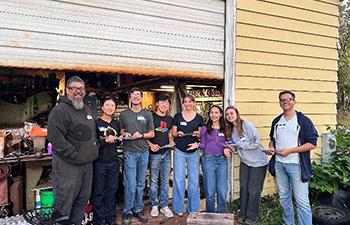
Project Manager
Aram Park
Mat Sci Club
Amount Requested
$5,000
Summary
The Bladesmithing Club, a subgroup of Mat Sci Club, is asking for a one-time investment to build a permanent on-campus forging setup that serves the whole Northwestern engineering and design community. For $5,000, we will build three outdoor forging stations to train more than 50 students a year through beginner workshops open to every major. Opening the stations to other student groups and classes pushes the yearly reach even further.
Planned Activities/Investments
All forging will happen in a designated area set up with Northwestern's Environmental Health and Safety and Risk Management offices, with flammables stored indoors in a dedicated cabinet. There is precedent: the Segal Iron Pour, run by Prof. Matthew Cummins, cleared EHS, liability, and facilities review and has run safely for years. Prof. Cummins is building his own metal-melting foundries this summer, and we will be collaborating with him.
We will build three forging stations, each pairing an anvil with a heat source so several people work at once. One commercial propane forge will be bought as the main forge; the other two we will build as a supervised club project. Once running, we will hold beginner workshops teaching forging fundamentals to anyone, regardless of major, and open the forge to other student groups and design classes. Small workshop donations will cover supplies and support club sustainability. This setup also supports the competition team by letting us make this year's blade entirely on campus for the first time and removing travel constraints.
A safety program will be in place before any forging starts: a mandatory safety and equipment session for every participant, PPE for all, fire safety equipment on hand, and faculty or trained-member supervision throughout.
Schedule
Fall 2026: Finish building the forge and hold one workshop. Start forging for FIERF Forging Competition (details announced July 2026).
Winter 2027: Finish forging, report, and video for FIERF. Hold 1-2 public workshops on forging and/or building a propane forge.
Spring 2027: Recruit new members, hold 1-2 public workshops, attend FIERF in May, and set up future leadership roles.
Fall/Winter 2027: Similar to 2026-27.
Spring 2028: Attend TMS Bladesmithing Competition in March and FIERF in May.
Impact
We will run 4-6 beginner workshops a year, starting with 6 non-club students per workshop, to train more than 30 unique students annually. Opening the stations to other student groups such as FSAE or as a collaboration with DSGN 376 (Prof Cummins’ class) will further increase the number of students trained. Given that we have five experienced members and 40 interested students after only brief word-of-mouth publicity, our community impact will only increase after we become more formally established on campus.
The forge gives anyone hands-on experience with materials science and manufacturing. Faculty researchers, art and design students, and other shop teams get an easy way to heat and work metal on campus, and the competition team can do high-quality work without the cost and access barriers of forging off-site like last year.
We will measure impact by tracking the following:
- Workshops held and unique participants trained
- Workshop participants who show further interest, and/or join the core team
- Finishing a competition blade on campus
- Other student groups and classes served
Deliverables
- Safety & Risk Management approval for an on-campus forge
- Purchase a commercial forge and build one complete forging station
- Build two more forging stations as student projects
- Write a safety protocol and conduct member safety trainings
- Host the first beginner forging workshop on campus (expected to be 6 members, 2 for each station)
- Forge FIERF (May 2027) and TMS (March 2028) competition items entirely with on-campus equipment
Sustainability
The club is built to outlast Murphy funding. As a sub-club of the Materials Science Club, it has an institutional home and year-to-year continuity. Consumable supplies do not depend on the grant: propane is cheap through the university's delivery service, and workshop steel is covered by participant donations. Only competition-grade steel recurs on the competition cycle, which we would seek each competition year again. We are also discussing supplementary funds with the Materials Science and Engineering department. Because the equipment is durable and the outdoor space permanent, the capability persists with little reinvestment.
Previous Project
Last year the team received Murphy funding to forge a blade for the TMS Bladesmithing Competition. However, we had to drive hours to Indiana to borrow a forge, which meant travel took much of our budget. This also limited the number of members as well as educational and forging time. This proposal shares that goal but takes a different approach: rather than fund another off-campus cycle, it builds permanent on-campus capability that supports a longer competition design process and opens forging access to the whole Northwestern community.
Budget Overview
-
Forging Stations: $2,600
-
One ready-built commercial double burner propane forge (comparable to Hell's Forge or VEVOR units); materials to build two more forges as a supervised club project, including firebrick, ceramic fiber insulation, a propane burner kit, hose and regulator, and steel shell stock; three anvils (one 110 lb Kanca double horn for general work, two 77 lb Kanca bladesmith anvils for detail work); five hammers of assorted styles and weights; four pairs of tongs in wolf jaw, V-bit, and flat styles (to safely hold all possible work pieces); and materials to build anvil stands and station bases.
-
-
Safety and PPE: $700
-
About ten pairs of leather welding gloves and six leather welding aprons (enough for a full workshop group at once); bulk safety glasses and hearing protection; a 5 lb ABC fire extinguisher; a fire blanket; and a full first aid kit.
-
-
Materials and Consumables: $380
-
Competition-grade high carbon bar stock (1084 or 5160) from a knifemaking supplier such as New Jersey Steel Baron; mild steel starter stock for workshops (later offset by workshop fundraising); and one gallon of Parks 50 quenching oil, the standard oil for hardening blade steels.
-
-
Storage and Mobility: $150
-
A heavy-duty steel service cart to store gear and move it to and from the outdoor forging area.
-
-
Skill Building and Setup: $350
-
Instructional resources and a paid intro forging course for two or three core student leaders at the Chicago Industrial Arts and Design Center.
-
-
Contingency and Miscellaneous Tooling: $320
-
Files, wire brushes, a center punch and scribe set, the first propane tank fill, and a buffer for shipping costs that run high on heavy steel items.
-
-
Club Long-Sleeve Shirts: $125
-
Custom-printed long-sleeve 100% cotton shirts for competition team members; long sleeves protect against burns during forging. Quote from Underground Printing: $249 for 10 shirts with front design only. This funding will allow us to subsidize half the cost of these team shirts.
-
-
Competition Travel Financial Aid: $375
-
The May 2026 FIERF competition was held in Fraser, Michigan. Past competitions have been held in the midwest region, such as Michigan and Ohio. As an example for our budget, a one-way Amtrak ticket from Chicago to Fraser costs $73-93 depending on the time. The funding of $375 will allow us to subsidize about 4-5 members’ travel costs by 50%.
-
Total Budget Amount: $5,000
Matching Funds
The Ford Engineering Design Center already provides belt grinding and finishing equipment free to all engineering students, as well as scrap steel bars we can use for workshops. Materials Science and Engineering professors, including our advisor Professor McCue as well as the NUANCE Center, have offered funding support before, and we expect to use those connections again if needed. On-campus storage and a designated forging area are pending EHS and facilities approval and would count as in-kind support once secured.
Faculty Adviser/Department
Ian McCue/Materials Science and Engineering