

Student ProjectsCompetition for Undergraduate Regenerative Engineering (CURE)
Project Manager
Riley Thornburgh, Andrew Kang
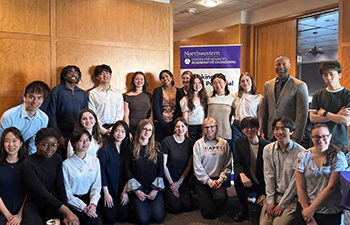
The CURE Club
Amount Requested
$4,954
Summary
Northwestern’s Competition for Undergraduate Regenerative Engineering (CURE) is a student-run organization that provides the opportunity for undergraduate students to engage in cutting edge research in the field of regenerative biomedical engineering. The mission of the club is to enable students from diverse backgrounds to work together in the development of novel therapies for global medical problems. The club is open to all to join and provides valuable hands-on lab training and research experience for new students while enabling more seasoned members to expand their skills in project management and experimental design.
For the 2026–2027 academic year, CURE will support three student-led research teams focused on regenerative medicine and chronic wound healing: a mesenchymal stem cell (MSC) therapy team, a copper- and cerium oxide nanoparticle-releasing hydrogel wound dressing team, and a cell sheet engineering team. Students will participate in all stages of the research process, including literature review, experimental design, biomaterial fabrication, cell culture, data analysis, and scientific communication. Teams will work closely with graduate student and postdoctoral mentors from the Ameer Lab.
Through these activities, students will gain hands-on experience with laboratory techniques, strengthen their leadership and project management, and develop skills in interdisciplinary research. The year culminates in presentations at the CARE Symposium on Regenerative Engineering at Feinberg, where students communicate their findings to academic and industry professionals.
CURE offers a unique opportunity for undergraduates to experience authentic research in a highly collaborative environment. By combining experiential learning with student leadership, the organization equips participants with the technical and professional skills needed for future careers in research, medicine, and engineering while contributing to the advancement of regenerative medicine.
Planned Activities/Investments
CURE organizes undergraduate students into multidisciplinary research teams that investigate regenerative medicine therapies with the support of the Ameer Lab. During the 2026–2027 academic year, three student-led teams will focus on mesenchymal stem cell (MSC) therapies, copper- and cerium oxide nanoparticle- releasing hydrogel wound dressings, and cell sheet engineering approaches for tissue regeneration and chronic wound healing.
Each team conducts both laboratory and computational research activities. Students perform literature reviews, design experiments, fabricate biomaterials, culture cells, collect and analyze data, and evaluate the translational potential of their technologies. Undergraduate members plan experiments, troubleshoot challenges, and present findings, while graduate students, postdoctoral researchers, and faculty advisors provide mentorship and technical guidance.
CURE intentionally recruits students from a wide range of disciplines, including biomedical engineering, chemical engineering, materials science, biology, data science, economics, and pre-medical studies. This interdisciplinary structure allows students to contribute in different ways, including laboratory experimentation, statistical analysis, market assessment, regulatory strategy, and scientific communication.
Throughout the year, teams participate in weekly project meetings, work in the lab, and attend club-wide meetings. These club meetings range from journal club meetings to a holiday party with the entire Ameer Lab.
Murphy Society funding will support the supplies necessary for these activities, including biomaterial synthesis reagents, cell culture supplies, assay kits, animal studies, and access to Northwestern core facilities for imaging and materials characterization. These investments directly enable undergraduates to conduct independent research and gain hands-on experience with experimental techniques that are otherwise inaccessible in traditional coursework.
The culmination of these efforts will be presentations at the CARE Symposium on Regenerative Engineering and other research conferences, allowing students to communicate their findings and showcase the impact of undergraduate-led innovation.
Impact
With growing undergraduate interest in both wet- and dry-lab research, CURE serves as a collaborative training environment where students gain hands-on experience in cell culture, experimental assays, data analysis, and other essential research techniques. The club fosters an inclusive community of aspiring biomedical researchers at Northwestern, providing experienced members opportunities to lead independent regenerative engineering projects while newer students receive mentorship from postdoctoral and graduate students. Undergraduate students of all skill levels are welcomed and trained to conduct rigorous, meaningful research that prepares them for future careers in academia, medicine, and industry.
Beyond student development, CURE contributes to the advancing field of regenerative engineering and chronic wound healing through student-led research conducted under the mentorship of graduate students and postdoctoral researchers. Our copper-releasing bioactive glass project has demonstrated promising wound-healing effects in diabetic mouse and porcine models, resulting in a manuscript currently under peer review. Additional projects, including a copper-releasing hydrogel dressing and a photo-controlled exosome bandage platform, aim to develop accessible and innovative therapies with enhanced antimicrobial and regenerative properties. The findings of these projects have the potential to inform future research in chronic wound therapies and improve outcomes for patients of chronic diabetic wounds.
Deliverables
One of the primary deliverables of CURE is participation in the biannual International CARE Symposium on Regenerative Engineering. This symposium embodies the “competition” aspect of Competition for Undergraduate Regenerative Engineering, as each team is given seven minutes to present its research proposal and preliminary findings. Through this process, students gain experience in scientific communication while receiving feedback and mentorship from faculty affiliated with the Querrey Simpson Institute for Regenerative Engineering (QSI-RENU).
In addition to conference presentations, CURE projects are designed to progress toward peer-reviewed publication. The Bioactive Glass team recently submitted a completed manuscript in collaboration with Professor Guillermo Ameer’s laboratory, while the mesenchymal stem cell (MSC) and copper/cerium oxide nanoparticle hydrogel teams are continuing to advance their projects toward publication.
As projects develop, students also have opportunities to present their work at conferences and research showcases such as the annual BMES Conference, the Chicago Area Undergraduate Research Symposium, and the Northwestern Undergraduate Research Expo. These experiences allow students to strengthen their presentation skills, engage with researchers in related fields, and build professional networks within biomedical engineering and regenerative medicine.
Sustainability
CURE has been an established organization at Northwestern for several years and continues to attract strong interest from undergraduate students seeking hands-on research experience. To support the club’s long-term sustainability, CURE has pursued funding through multiple avenues, including the McCormick Student Advisory Board (MSAB), the Associated Student Government (ASG), and the Murphy Society Grant from prior years. The club also benefits from institutional support through its collaboration with the Querrey Simpson Institute for Regenerative Engineering (QSI-RENU) and Professor Guillermo Ameer’s research group.
Through this partnership with the Ameer Lab, CURE receives ongoing logistical, technical, and educational support from graduate students and postdoctoral researchers. This mentorship structure enables continuity in student training, project development, and leadership transition, helping ensure the club’s long-term sustainability beyond the duration of individual grant cycles.
Previous Project
With support from the Murphy Society grant, CURE previously developed three regenerative engineering projects focused on treating chronically inflamed wounds such as diabetic foot ulcers: (1) a sustained copper-ion releasing bioactive glass, (2) a mesenchymal stem cell (MSC) platform for regenerative extracellular vesicle release, and (3) a copper- and cerium oxide-releasing hydrogel dressing.
Since receiving funding, the club has made significant progress across all three projects. Most notably, the bioactive glass team successfully developed a sustained copper-releasing bioactive glass with promising wound-healing effects demonstrated through both in vitro studies and in vivo mouse and porcine models. This project has since been completed, and a manuscript describing the work has been submitted to a peer-reviewed journal for publication.
In parallel, the MSC and hydrogel teams continue to advance their respective projects toward publication and translational application. All three teams presented their work at the 2024 Symposium for Regenerative Engineering in Chicago, providing students with opportunities to communicate their research and receive feedback from experts in the field.
With the recent submission of the bioactive glass project’s manuscript, that team has now expanded into a new project focused on developing optogenetically activated cell sheets capable of spatiotemporally controlled release of anti-inflammatory cytokines for regenerative therapies.
Budget Overview
- Upcell plates (1 pack): $1,383.65
- Fibronectin (1):$830.50
- Bioreactor (1 case): $1584
- Antifungal (5 x $92.25): $461.25
- 10mL pipettes (1 case): $166
- 25mL pipettes (1 case): $222.65
- DPBS (1 case): $75.60
- Dermal fibroblast media (3 x $76.70): $230.10
Total Budget Amount: $4,953.75
Matching Funds
The CURE club has received support from ASG to sustain basic operations. In addition, our collaboration with Professor Guillermo Ameer’s laboratory and the Querrey Simpson Institute for Regenerative Engineering (QSI-RENU) provides in-kind support through access to laboratory space, shared research resources, and mentorship from graduate students and postdoctoral researchers.
Faculty Adviser/Department
Guillermo Ameer/Biomedical Engineering