Inside Our ProgramProgram Events
Events
-
Aug27
EVENT DETAILS
less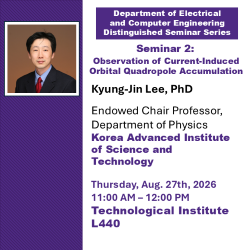
Observation of Current-Induced Orbital Quadrupole Accumulation - An ECE Distinguished Seminar with Professor Kyung-Jin Lee (Seminar 2 of 2).
Please join us in the Electrical and Computer Engineering Department at the Technological Institute for an hour-long seminar with Professor Kyung-Jin Lee of the Korea Advanced Institute of Science and Technology.
Abstract:
Spintronics and orbitronics rely on current-induced accumulations of magnetic dipoles: spin [1, 2] and orbital angular momentum [3–5]. However, electronic orbitals inherently carry multipoles beyond the dipole, with the rank-2 orbital quadrupole as the leading term. Here we use polarization-resolved Kerr microscopy to observe current-induced orbital-quadrupole accumulation at the surfaces of Ti and Pt, metals with markedly different spin–orbit-coupling strengths. By separating the symmetric and antisymmetric components of the off-diagonal optical conductivity, we isolate the time-reversal-even quadrupolar response from the conventional time-reversal-odd magnetic-dipolar one, and find that the quadrupolar optical response exceeds the dipolar one in both metals. First-principles analysis of the measured responses indicates that the quadrupole accumulations are of the same order of magnitude in the two metals despite their widely different spin–orbit-coupling strengths, consistent with a previously unidentified channel of charge-to-orbital conversion that does not require spin–orbit coupling. Our findings establish that current-induced orbital polarization is fundamentally multipolar, expanding current-induced phenomena from the dipolar to the multipolar regime and opening a route to electrical control of orbital-ordered phases.
[1] Y. K. Kato, R. C. Myers, A. C. Gossard & D. D. Awschalom, Observation of the spin Hall effect in semiconductors. Science 306, 1910–1913 (2004).
[2] C. Stamm et al. Magneto-optical detection of the spin Hall effect in Pt and W thin films. Phys. Rev.
Lett. 119, 087203 (2017).
[3] Y.-G. Choi et al. Observation of the orbital Hall effect in a light metal Ti. Nature 619, 52–56 (2023).
[4] I. Lyalin, S. Alikhah, M. Berritta, P. M. Oppeneer & R. K. Kawakami, Magneto-optical detection of the orbital Hall effect in chromium. Phys. Rev. Lett. 131, 156702 (2023).
[5] Y. Marui et al. Spin and orbital Hall currents detected via current-induced magneto-optical Kerr effect in V and Pt. Phys. Rev. B 108, 144436 (2023).
Bio:
Kyung-Jin Lee received his B.S., M.S., and Ph.D. degrees from Korea Advanced Institute of Science and Technology (KAIST). He was a postdoctoral fellow at SPINTEC, France, from 2003 to 2005. In October 2020, he joined Department of Physics at KAIST, where he is currently a KAIST Endowed Chair Professor, following five years at Samsung Advance Institute of Technology and fifteen years at Korea University. He is an APS Fellow and the recipient of various awards including the Science and Technology Merit Metal from the Korean government and the Samil Prize (Natural Sciences) from the Samil Foundation. His current research interest includes orbital dynamics and quantum spin transfer.
Tech Room Finder - L440
TIME Thursday, August 27, 2026 at 11:00 AM - 12:00 PM
LOCATION L440, Technological Institute map it
CONTACT Lee Onysko lee.onysko@northwestern.edu EMAIL
CALENDAR Department of Electrical and Computer Engineering (ECE)
-
Aug26
EVENT DETAILS
less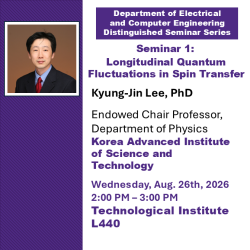
Longitudinal Quantum Fluctuations in Spin Transfer - An ECE Distinguished Seminar with Professor Kyung-Jin Lee (Seminar 1 of 2).
Please join us in the Electrical and Computer Engineering Department at the Technological Institute for an hour-long seminar with Professor Kyung-Jin Lee of the Korea Advanced Institute of Science and Technology.
Abstract:
Spintronics has transformed our ability to generate, transfer, and manipulate angular momentum in solids, enabling powerful strategies for current-driven control of magnetic states and devices. Despite its remarkable success, the field has traditionally been built upon three simplifying assumptions: a classical description of localized spins (magnetic moments), exchange interactions that act purely between spin degrees of freedom, and the predominance of spin dipole moments as the primary carriers of angular momentum. This talk explores what new physics emerges when these assumptions are relaxed and when additional internal degrees of freedom are taken seriously.
In particular, I will discuss the role of longitudinal quantum fluctuations in spin transfer processes [1], revealing regimes where angular momentum transport cannot be captured by conventional transverse spin dynamics. I will then introduce current-driven control of magnetism mediated by orbital exchange interactions [2], highlighting how orbital degrees of freedom provide a qualitatively new channel for coupling electric currents to magnetic order. If time permits, I will also present multipolar pathways for angular-momentum transport that go beyond conventional dipolar mechanisms [3], opening a broader framework for spintronics and orbitronics in which higher-rank moments play an active and controllable role.
[1] T. Lee et al., “Signatures of longitudinal spin pumping in a magnetic phase transition,” Nature 638, 106–111 (2025).
[2] G.-H. Lee, K.-W. Kim, and K.-J. Lee, “Orbital exchange-mediated current control of magnetism,” Nat. Commun. 17, 2236 (2026).
[3] H.-W. Ko and K.-J. Lee, “Magnetic octupole Hall effect in d-wave altermagnets,” arXiv:2508.00794
Bio:
Kyung-Jin Lee received his B.S., M.S., and Ph.D. degrees from Korea Advanced Institute of Science and Technology (KAIST). He was a postdoctoral fellow at SPINTEC, France, from 2003 to 2005. In October 2020, he joined Department of Physics at KAIST, where he is currently a KAIST Endowed Chair Professor, following five years at Samsung Advance Institute of Technology and fifteen years at Korea University. He is an APS Fellow and the recipient of various awards including the Science and Technology Merit Metal from the Korean government and the Samil Prize (Natural Sciences) from the Samil Foundation. His current research interest includes orbital dynamics and quantum spin transfer.
TIME Wednesday, August 26, 2026 at 2:00 PM - 3:00 PM
CONTACT Lee Onysko lee.onysko@northwestern.edu EMAIL
CALENDAR Department of Electrical and Computer Engineering (ECE)
-
Aug26
EVENT DETAILS
lessCybersecurity Reasoning Systems (CRSs) combine large language models with tools, program-analysis techniques, execution feedback, and control logic to discover and repair vulnerabilities in real software. Recent systems have demonstrated increasingly strong capabilities, but a persistent gap remains between what these systems appear to achieve and our understanding of why they work. Aggregate success rates on fixed benchmarks reveal little about which components are responsible for these capabilities, whether those components remain useful as foundation models improve, or whether a system can recognize objectives that cannot be achieved. These questions are further complicated by benchmark issues such as answer leakage, environment failures, incomplete oracles, and unintended solution shortcuts.
This thesis examines the capabilities and limits of autonomous cybersecurity reasoning systems, with a particular focus on the mechanisms that give rise to those capabilities. In this talk, I will summarize my prior work on automated vulnerability discovery and repair, including our work on CRSs developed for the Artificial Intelligence Cyber Challenge (AIxCC). I will discuss how these systems combine language-model reasoning with fuzzing, program analysis, execution feedback, and other specialized components, and what their behavior reveals about the sources of end-to-end capability.
I will then discuss broader questions that emerge from this work: which system components remain valuable as foundation models improve, how benchmark design affects the conclusions we draw about system capability, and whether these systems can recognize when a task cannot be completed under specified constraints. Together, this work aims to move beyond aggregate success rates toward a more concrete understanding of how cybersecurity reasoning systems work, how their capabilities generalize, and where their boundaries lie.
TIME Wednesday, August 26, 2026 at 7:00 PM - 8:00 PM
CONTACT Jensen Smith jensen.smith@northwestern.edu EMAIL
CALENDAR Department of Computer Science (CS)
-
Sep24
EVENT DETAILS
lesstba
TIME Thursday, September 24, 2026 at 9:00 AM - 11:00 AM
LOCATION 3514, Mudd Hall ( formerly Seeley G. Mudd Library) map it
CONTACT Wynante R Charles wynante.charles@northwestern.edu EMAIL
CALENDAR Department of Computer Science (CS)
-
Sep28
EVENT DETAILS
lessMonday / CS Seminar
September 28 / 12:00 PM
Hybrid / Mudd 3514Speaker
TBATalk Title
TBAAbstract
TBABiography
TBA---
Zoom Link
Panopto LinkTIME Monday, September 28, 2026 at 12:00 PM - 1:00 PM
LOCATION 3514, Mudd Hall ( formerly Seeley G. Mudd Library) map it
CONTACT Wynante R Charles wynante.charles@northwestern.edu EMAIL
CALENDAR Department of Computer Science (CS)
-
Oct5
EVENT DETAILS
lessMonday / CS Seminar
October 5 / 12:00 PM
Hybrid / Mudd 3514Speaker
Brian Suchy, Software Engineer Google DeepMindTalk Title
Formal Relational Equivalence for SQL, GenAI, and BeyondAbstract
Verifying that complex query rewrites from database optimizers or AI-driven generators preserve exact bag semantics under three-valued logic is an NP-hard challenge. To address this, we present an MLIR-native compiler framework that formally reasons about relational algebra. By decoupling query semantics from specific execution engines and lowering queries into a unified Relational Algebra Intermediate Representation, our language-agnostic methodology definitively proves semantic equivalence across all possible database states.The core of the presentation will deep-dive into our multi-tiered proving architecture, which synthesizes several advanced academic methodologies. First, we utilize E-Graphs and Equality Saturation to rapidly explore the equivalence space and detect structural congruence between query abstract syntax trees using fast, algebraic rewrite rules. Second, we employ Semiring Arithmetic, treating relational algebra as expressions over K-relations to leverage algebraic simplification and canonical forms under semiring laws. Finally, we implement a First-Order Logic and SMT translation path, lowering Relational Algebra into Relational Calculus and then into First-Order Logic to evaluate constraints and domain-specific axioms using parallel solvers like Z3 and CVC5, which either formally proves equivalence or synthesizes concrete counter-examples.
Finally, we will discuss the practical implications of combining these formal mathematical methods with modern compiler design. Attendees will leave with a comprehensive understanding of how bridging database theory, equality saturation, and SMT solving can create robust solutions for verifying query optimizers, enforcing semantic correctness, and validating automated SQL generation at scale.
Biography
Brian Suchy is a Software Engineer within Google DeepMind.
In his time at Google he has worked on F1 Query (Google's internal SQL query engine), hardware development, and (of course) AI.
Prior to joining Google, Brian received his PhD student at Northwestern University, advised by Peter Dinda, with a focus on hardware/software codesign and memory management.Research Interests: Artificial Intelligence, Query Processing and Formal Logic
---
Zoom Link
Panopto LinkTIME Monday, October 5, 2026 at 12:00 PM - 1:00 PM
LOCATION 3514, Mudd Hall ( formerly Seeley G. Mudd Library) map it
CONTACT Wynante R Charles wynante.charles@northwestern.edu EMAIL
CALENDAR Department of Computer Science (CS)
-
Oct29
EVENT DETAILS
lesstba
TIME Thursday, October 29, 2026 at 9:00 AM - 11:00 AM
LOCATION 3514, Mudd Hall ( formerly Seeley G. Mudd Library) map it
CONTACT Wynante R Charles wynante.charles@northwestern.edu EMAIL
CALENDAR Department of Computer Science (CS)
-
Nov19
EVENT DETAILS
lesstba
TIME Thursday, November 19, 2026 at 9:00 AM - 11:00 AM
LOCATION 3514, Mudd Hall ( formerly Seeley G. Mudd Library) map it
CONTACT Wynante R Charles wynante.charles@northwestern.edu EMAIL
CALENDAR Department of Computer Science (CS)