Calculated Risk
A consulting project with medical device company Convatec inspired five MEM graduates to launch their own startup, HexaOne Associates.
The opportunity was too good to pass up. So was the chance that came next.
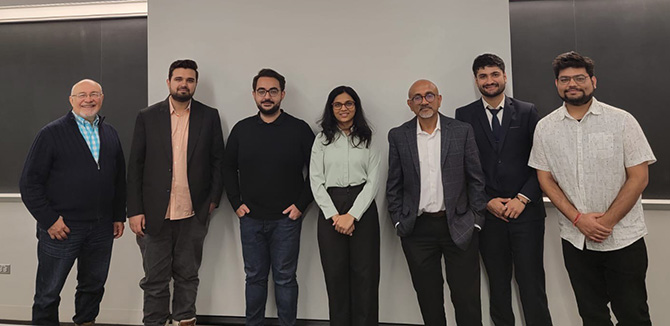
When Ashar Fatmi (MEM ‘25), Vardhman Hundia (MEM ‘25), Baqir Naqvi (MEM '25), Anusha Rangashamaiah (MEM ‘25) and Shubham (MEM ‘25) learned about the chance to tackle risk management challenges for medical device company Convatec, they did not hesitate.
“It was an immediate ‘yes’ from us,” Fatmi said. “It presented a tangible, real-world challenge that perfectly aligned with the core tenets of the MEM program.”
Convatec needed help standardizing risk management across five distinct business units. Professor Yuri Balasanov selected the students for a 10-week consulting engagement from a highly competitive pool of MEM students. The selection process aimed to identify those who could tackle complex technical challenges while effectively communicating solutions to top company executives.
“We were incredibly proud to be selected,” Rangashamaiah said. “The emphasis was on our ability to work collaboratively on multifaceted challenges, which is absolutely key for successful consulting engagements like this.”
The project wasn’t tied to course credit but functioned as an industry immersion experience. Convatec held the students to professional consulting standards, treating them as external advisers. In doing so, the project served as a real-life consulting engagement in which the students were expected to deliver actionable insights and solutions, Shubham said.
But the team faced some major hurdles in reaching that goal. Organizational alignment proved difficult across Convatec’s diverse business units, each with unique workflows and pain points. Data fragmentation created another challenge, with inconsistent risk logs that lacked common metrics.
The students spent their first three weeks interviewing stakeholders across departments. Through that process, they learned the importance of active listening and empathetic inquiry.
“It wasn’t just hearing what people said but understanding why they felt that way,” Hundia said.
The MEM curriculum proved directly applicable throughout the project, the students said. Through MEM they learned to view Convatec's challenges holistically while also understanding how to quantitatively support their risk analysis framework.
“The MEM program isn’t just theoretical," Naqvi said. “It provides the strategic toolkit and mindset to truly train you to be a versatile problem-solver at the intersection of technology and business.”
The student team’s solution combined process improvements with technology enhancements. The team developed a standardized risk management framework and integrated quantification systems into existing project management tools.
Convatec’s leadership responded enthusiastically to the final presentation. The students structured their recommendations as a compelling narrative that served as a strategic roadmap for improvement rather than just a data presentation.
“It turned out to be a larger undertaking than what we originally imagined, but the students came through by putting in a lot of extra work,” said Dinendra Ramachandran (MEM '05), Convatec’s vice president of digital health solutions. “They got some great exposure to how project risks are currently managed.”
The team’s success on the project gave the students confidence in their collective abilities and revealed a broader market opportunity. They officially launched their own company — HexaOne Associates — positioning themselves as digital operations partners for industrial sectors.
“This project was a true catalyst for us,” Naqvi said. “The synergy we discovered as a team, the depth of the problem-solving we engaged in, and the clear market need we identified through our work with Convatec inspired us to take the leap.”
Their startup focuses on helping companies modernize workflows and operations through targeted technology solutions.
The team plans to launch an AI-powered risk management solution as one of its first products.
“We're incredibly grateful to the MEM program for providing us with such a transformative opportunity,” Fatmi said. “We're excited for what the future holds and look forward to continuing to apply the principles we honed here.”