

Student ProjectsSC8 Break and Tire System Overhaul
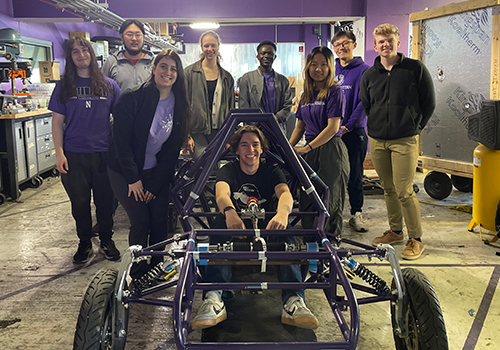 Project Manager
Ethan Flood, NUsolar
Amount Requested
$5,000
Summary
The Northwestern Solar Car Team (NUsolar) is a student-run organization that designs and manufactures fully functional, road-certified solar vehicles. Our team is made up of over 40 undergraduate students across Northwestern’s many schools, and our mission is to enhance the education and career preparation of Northwestern students by providing hands-on engineering, design, manufacturing, and management experiences. We provide students with an outlet to demonstrate their skills and commitment to potential employers, while also promoting future technology advancements in sustainable energy transportation by demonstrating the feasibility of solar power.
During the 2024-2025 academic year, our team has focused on the manufacturing of our next-generation solar vehicle: SC8. To continue improving upon the capabilities of our current vehicle, our team must incorporate a new, high-performance brake system in order to improve energy efficiency, ease of workability, and ensure endurance on the track.
Brakes are one of the most crucial systems for safety and efficiency on a track. Brackets ensure that you stop in time to prevent collisions, allow rapid acceleration between turns, and allow for smooth turns that decrease tire wear. This system needs maintenance and needs to be changed with wear, which will be incurred in the span of a track race. Our current tires and brakes are old to the point where they have reached their lifetime and have caused detrimental issues to our system due to rust, corrosion, and material degradation. This means that our entire system needs to be switched out to prevent any failures, as one component failing will result in the entire system going down. Additionally, to properly endure the 3-day endurance race that is Formula Sun Grand Prix (FSGP), we need to have at least one additional set of everything, both as a backup and to switch out as the track wears down our tires and brake pads. Overall, both for safety and to push our car to be endurance track-ready, a new brake and tire system is needed.
This year, our team seeks Murphy Society funding to support an in-depth investigation of the brake system it takes to create and maintain an endurance solar car. This would allow us to upgrade our car to be able to endure the intensity and length of the FSGP track. More specifically, funding would support a study of automotive brakes, wheels, track maintenance, and performance led by our mechanical team of over 20 undergraduate members. Through the testing of different system combinations and maintenance schedules, our students can effectively plan and execute a track maintenance schedule to ensure efficiency when switching out worn components while also minimizing the risk of errors during assembly of the brake system.
Planned Activities/Investments
To meet the requirements of a race-ready solar car, NUsolar’s mechanical team will carry out a series of manufacturing, testing, and maintenance activities focused on brake and tire systems. We will begin by learning how to set up and maintain a complete brake system, including pressurizing handbrake lines, flushing and bleeding lines, balancing tires, and machining or grinding rotors. Our team will conduct a wide range of performance tests, such as assessing braking behavior under different weight distributions, measuring tire depressurization over time, comparing handbrake types and efficiency, and testing the durability of brake lines and wear patterns of brake pads. Additionally, we will evaluate rotor materials and monitor how quickly rotors warp under repeated use. This process will culminate in the creation of a formal maintenance and track wear schedule, through which we will document the degradation of brake pads and tires during simulated race conditions. These activities will both improve the reliability of SC8 during the three-day FSGPendurance race and provide critical hands-on learning opportunities for team members in high-performance mechanical system design and testing.
Impact
The main priority of our organization is to provide an educational, hands-on experience that cannot be found in any course or independent study. Performing an in-depth manufacturing investigation and system overview advances this mission by creating opportunities for students to immerse themselves in the intricacies of brake systems, automotive track maintenance, wear of materials, and manufacturing through an open-ended, collaborative project. This type of work promotes the problem-solving critical to success in industry and academia, and will push members to develop leadership, project management, and technical skills that will be useful throughout their future careers. Additionally, the results of this project will greatly expand our team's ability to work with high-performance race settings and brake systems, improving the efficiency and national competitiveness of our future vehicles.
Deliverables
The major deliverables for the project:
- A well-documented manufacturing and testing plan that equips our team, and future iterations of our team, with the knowledge necessary to maintain a brake system during an endurance race for our future vehicles and racing.
- Comprehensive performance data that allows our team to incorporate these brake system materials - including but not limited to calipers, brake pads, brake lines, hydraulic brakes, cable brakes, rotors, tires, rims -into our vehicle designs.
- Robust processing and testing equipment that future team members can utilize to rapidly produce and assess brake systems.
- The clear identification of processing and fabrication pitfalls, critical to the success of our team’s advancement towards the completion and finale of the Formula Sun Grand Prix race.
Sustainability
This project is planned to take one year, with the potential to grow into a larger study supported by our team, and will be covered mostly with Murphy Society funding, with NUsolar’s current funds being used to cover any additional funding necessary. This transition to an organizationally supported project would occur at the conclusion of the coming year and would represent the project becoming a permanent feature of our design cycle that builds off the knowledge and equipment developed throughout the year.
Previous Projects
Last year, NUsolar received Murphy Society funding to complete the manufacturing of a full-scale carbon fiber aeroshell for our next-generation solar vehicle, SC8 (“Bastet”). Building upon earlier years of research and material testing, we fine-tuned key composite layup procedures, including experimentation with various carbon fiber weaves, vacuum bagging configurations, and epoxy resins. With the help of reusable tools such as a vacuum pump, vacuum chamber, squeegees, and mold prep supplies, we completed the top shell layup reinforced with foam-core carbon fiber rib panels. Importantly, this was a team-wide effort—“layup days” involved students across subteams working together in the shop, gaining hands-on experience with composite fabrication and PPE safety protocols. The result was a completed structural component for Bastet that advanced our vehicle design and gave over 30 students practical training in composite manufacturing.
Budget Overview
Brake System Components – $3,109.85
- This includes Wilwood calipers (PS1 and GP200), brake lines, adapters, handbrake components, connectors, and fluid. These parts will allow us to build and test multiple full brake system configurations and maintain backup components for endurance racing.
Rotor and Braking Hardware – $945.24
- Covers raw material stock for rotors, brake clean supplies, and sealants used for system flushing and component longevity during high-use track simulations.
Tire and Wheel System – $2,240.48
- Includes two full sets of tires and rims, as well as kits and tools for placing tires on rims, balancing wheels, and bead blasting—ensuring full redundancy and track readiness.
Testing and Maintenance Equipment – $478.67
- Encompasses tools and kits for brake line bleeding, vacuum pulling, and wheel balancing—critical for system testing, tuning, and maintenance throughout the race season.
Total Budget Amount: $6,774
Faculty Adviser/Department
Nivedita Arora/Electrical and Computer Engineering