

Student ProjectsNorthwestern Bladesmithing Team
 Project Manager
Hayden Williams, Materials Science Club
Amount Requested
$5,000
Summary
The Northwestern University Bladesmithing Team (NUBS) seeks funding to forge a steel blade and enter it into the bi-annual TMS (Minerals, Metals, and Materials Society ) Bladesmithing Competition held in San Diego in Winter 2026. The club, formed in Spring 2025, comprises majors from materials science, chemical, and mechanical engineering, along with computer science and applied math. Using our engineering knowledge, we will combine both modern and traditional manufacturing techniques by hand forging a steel blade of our own design with a hot furnace and an anvil, subsequently 3D printing the handle. The blade is judged on many aspects, including mechanical properties characterization, forging process, and blade aesthetics. As a note, the blade is not sharpened; it is a tool for understanding metallurgy and combining interdisciplinary experience.
To deepen our understanding of metallurgy, we have been learning the science behind blade forging through guest lectures and discussions with previous competition winners. By attending a bladesmithing class at a local forge, we explored the connection between coursework and practical skills. Afterwards, we selected an alloy composition by combining the expertise of a local bladesmith with our analysis of material properties, such as hardness and corrosion resistance, through material database research. We began testing heat treatments to optimize blade properties using the chosen alloy. Our next steps are to create Computer-Aided Design (CAD) models to aid in the forging of our blade and handle. The final result includes the final blade alongside poster and video deliverables for the competition.
Finally, we hope to attend the competition held in March 2026 to learn from other schools competing from around the country, as well as from industry leaders. Our blade will be judged alongside an oral presentation and technical report. We believe this will add significant value to the undergraduate experience as it is a project that incorporates interdisciplinary engineering practices, including alloy selection and tempering process (materials science and chemical engineering), as well as blade design and crafting (mechanical and computer science). This interdisciplinary challenge highlights the McCormick philosophy of “Whole Brain Engineering”, while being educational and engaging for students.
Planned Activities/Investments
The bi-annual bladesmithing competition we seek to attend is held concurrently with the TMS professional society exhibition. This would provide an excellent opportunity to connect and interact with other students, professors, and industry representatives, forging personal and professional relationships.
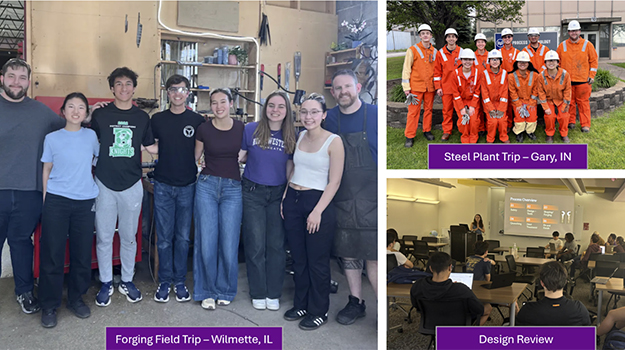
We have many planned activities for NUBS, the first of which is our first visit to the actual forge, where we will be making our blade. It is run by a local forge master who has experience in teaching undergraduate forging, and will be the first of many trips needed to effectively hone our material. The blade material we chose is a specialty alloy designed and sold by local company QuesTek, requiring initial investment in procuring the material. Moreover, we have conducted heat treatment experiments to determine ideal processing parameters for the given material, which we will use in heat treating the final blade after forging. CAD modeling will create the final handle, which will be resin 3D printed to our custom blade design. Finally, characterization of the final blade (i.e., hardness and microstructure) to assess its performance is critical, though it requires initial investment. During creation, we will conduct design reviews to encourage collaboration and enhance the final product design. Moreover, students will rigorously document the project progress for the final video presentation and report.
We also desire to attend more field trips to learn more about the forging process, such as metalworking classes in the Chicago Industrial Arts and Design Center, as well as a trip to QuesTek to learn more about our alloy. In addition, we have received interest from professors at Northwestern, such as Professors Ian McCue and Rajan Kumar, who would like to give guest lectures related to metallurgical engineering, helping us further understand the plethora of scientific and engineering practices involved. In terms of a more social aspect, we have many ideas for community activities such as smithing trivia and “Forged in Fire” watch parties. Overall, there are many opportunities and experiences that would enhance students’ skills and the overall value of their experience.
Impact
This project will first have a strong impact on the undergraduate students who make up the team and the broader community. By providing a hands-on, out-of-the-classroom experience, NUBS allows students to apply engineering concepts in tangible ways, fostering collaboration and community. Through exposure to metallurgy, process design, and manufacturing, we aim to spark interest in these fields and build foundational critical thinking and design skills. NUBS will also facilitate connections beyond the classroom. Field trips, speaker events, and forge access will help build lasting relationships with local companies and experts. Professors will gain a new avenue to support students by recommending NUBS as a practical and engaging engineering opportunity. We also hope to directly impact students beyond NUBS through live demos at an open house open to all students, with the goal of expanding the team. In an intro materials science class taken by most engineering majors (MSE 201), we plan to additionally have a live demonstration session. Finally, collaborations with businesses such as QuesTek for material procurement will expand McCormick’s network, potentially opening pathways for internships and full-time roles for future students.
Deliverables
- Acquire steel alloy from QuesTek by September 15
- Start forging the blade by October 15
- Finish forging the blade by November 23
- Finish the handle by December 5
- Finish heat treating and material characterization by December 13
- Finish the poster, video, and report by January 19
- Finalize competition funding by Feb 1
- Finish competition presentation by Feb 15
- Attend the competition from March 15-18
- Finalize future team roster and leadership by May 15
- Have initial design review for future competition by May 30
Sustainability
We are lucky to have a team of over half underclassmen who are deeply involved and interested in this project. Underclassmen have been pivotal in the mechanical design and research components thus far, and plan to continue competing in future years. The competition is hosted every two years, so the next NUBS team will have an extra year to carefully plan, create, and present an improved blade to all the other schools, showcasing “Whole Brain Engineering” across the country. In terms of beyond Murphy funding, NUBS is a project that is housed under the Materials Science Club, which has provided funding for the previous quarter and, in subsequent years, will be able to partially fund NUBS social events. Furthermore, Professor Ian McCue has expressed great interest in this project and has stated he will grant us a portion of his discretionary fund to NUBS if needed in the future. Finally, the Materials Science and Engineering curriculum offers numerous opportunities for student-led projects, which students can select to use as an extension of NUBS.
Budget Overview
Materials:
- 3D Printing Materials (prototyping): $300
- Procurement of Alloy (initial quote from QuesTek): $1,300
Laboratory Costs:
- Mat Ci Facility (Sample preparation and characterization): $500
- Other lab expenses are covered by matching funds
Travel to Forging Expenses:
- Gas (4 trips, 3 cars/trip, 200 miles round trip per car): $500
- Space Rental at Forge: $200
Final Deliverables:
- Video equipment rentals: $100
- Poster/presentation Supplies: $100
Competition Expenses:
- Shipping Final Blade to Competition: $150
- Partial Travel Expenses (~10 students): $750
Additional Events:
- Educational Field Trips: $500
- Speaker Events: $300
- Social Events: $300
Total Budget Amount: $5,000
Matching Funds
Materials Science Department (general) - $2000
NUANCE Center (material characterization and analysis) - $1000
Faculty Adviser/Department
Kathleen Stair/Materials Science Department