

Student ProjectsNorthwestern Formula Racing
Project Manager
Anton Walvoord, Northwestern Formula Racing
Amount Requested
$5,000
Summary
Northwestern Formula Racing (NFR) is a student-led engineering team that designs, builds, and races a fully electric formula-style vehicle for the international Formula SAE Electric competition. Our project seeks funding to support essential materials and component fabrication for our 2026 season. This campaign will directly empower undergraduate engineers to apply their classroom knowledge to a highly technical, hands-on project that fosters innovation, leadership, and real-world problem-solving.
This past year, our team has had great success, creating our first fully driving electric vehicle in the team's history. We placed 23rd overall in the competition, and we intend to become even more competitive this year. In order to pursue these goals, our team needs to show growth in both performance and design. Because of this, we are pursuing an all-new drivetrain configuration utilizing hub-mounted motors in our front two wheels in addition to a single motor with a rear differential. In the past, we have designed around rear-wheel drive, but with all-wheel drive, we can take greater advantage of our traction with the ground. Additionally, individual hub-mounted motors allow us to deliver different amounts of torque to each wheel, enabling us to provide more power to the wheels with the best traction. Besides performance, this configuration provides many new engineering challenges to solve, which we believe will help develop the skills of the students on our team.
In order to accomplish this goal, we will need entirely new motors suited to this new mounting location. We also need to make modifications to our existing custom inverter and assemble and test a new copy for each motor. These purchases will allow us to create a car that is not only more performant but also provides a greater learning opportunity for our student engineers. Successfully implementing these changes will also enable us to make the jump in future years to hub-mounted motors for all four wheels, which provides even further benefits.
Planned Activities/Investments
Our request for this investment is funding to purchase the equipment required to implement front-wheel drive hub-mounted motors in addition to our rear drivetrain. This will provide both a massive learning opportunity for the team as well as a significant competitive advantage. The major expenses for this include the motors themselves as well as the components required to drive said motors. The motors that we will need to purchase are two MA-3D 25 KW motors, which will be needed to drive the front wheels.
A major step that we took last year towards developing the hub motor system was to design a custom traction inverter to improve our drivetrain efficiency and significantly reduce its cost, as well as provide a significant learning opportunity for our team and a competitive advantage. In fact, out of more than 80 teams at the competition, our team was one of only three to successfully build a custom inverter. Although we already built this inverter, we need to develop a new version for the front motors and are hoping to transition from an IGBT to a SiCFET platform. This will allow us to further improve the efficiency, but will bring on new technical challenges and require us to have better testing infrastructure to be able to characterize and validate our designs using techniques such as double pulse testing. For that, we will need an oscilloscope and probes that are properly rated for our DC bus voltage. We would like to purchase the TBS2104B oscilloscope from Tektronix.
Impact
Northwestern Formula Racing is a wonderful resource for student engineers and anyone interested in engineering, allowing them to apply what they've learned in the classroom to a real-world project. Everyone is welcome, and students are able to experience the entire design cycle — from initial ideation, to manufacturing and testing, and finally to assess areas of improvement. Additionally, NFR provides students with experience working in a collaborative environment that relies on close communication, developing their interpersonal skills as well as technical skills.
Aside from engineering, our team also has an operations division focused on financial and outreach tasks. Students can learn skills in contacting sponsors and managing team budgets. This allows engineering students to grow their non-technical skills and provides non-technical students with an opportunity to get involved.
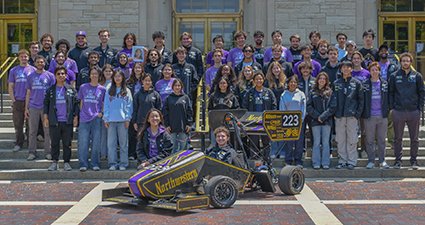
This past year, we’ve cultivated a group of around 60 students who regularly contribute to our club. Throughout the year, we ask our members for feedback on their development and experience, ensuring we're helping them grow their skills. We can see the impact the club has had on the work that our members complete. From machined components to student-designed PCBs, it’s easy to see how the level of quality improves as students progress through the club. There are countless stories of members who talk at length during interviews about the work they’ve accomplished at NFR.
Deliverables
To achieve our goal of an all-wheel drive EV, there are several major deliverables we need to achieve. First, in order to power the front motors, we need new custom inverters that will take power from our high-voltage battery and deliver it to the motors in a controlled manner. These inverters will be modified versions of our previous year's design, iterating on software and hardware that we know works. We will be designing and manufacturing all in-house and then testing them with our new motors.
Second, we need an all-new suspension system, which will be sized to fit new wheel uprights that can accommodate hub-mounted motors. Additionally, to properly utilize the power from the motors, we will need a custom gearbox. These designs are already in development, and we aim to have our suspension geometry finalized by August 3. Following that, we aim to move into manufacturing and assembly as soon as possible, with a deadline of February 14 for a fully rolling chassis.
Finally, we will need to redesign and manufacture our cooling and wiring system in order to properly deliver power and coolant from the rear of the car to the nose. Coming from a fully rear-wheel drive system, our previous designs all house these components at the rear of the car. We will need to make additions and modifications such that front-wheel drive motors can be fully utilized.
Sustainability
In addition to funding from the Murphy Society, we are supported by a large number of sponsors with whom we keep close ties. These sponsors often assist the team with both monetary and in-kind donations and have given us feedback on our designs. We are also supported by donations from current and prior members, last year raising almost $8,000 during our Catalyzer campaign. We keep close connections with our alumni who provide generous support in knowledge as well as finances. The support from donations and sponsors comprises a large portion of our team's finances and supply of materials.
In addition to our current support, we have ambitions to pursue additional sponsorship opportunities, as well as expand our alumni and family outreach. We have an ongoing newsletter about our progress and plans, and have intentions to reach out to Northwestern magazines and newspapers for featured segments to draw further attention and support. The success of our past year provides us with an opportunity to communicate the major strides we’ve made and pursue more elusive sponsorships.
We hope that support from the Murphy Society will allow us to pursue even more technically impressive and performant designs, and this will continue to make us more desirable for sponsors and donors.
Previous Projects
Last year, we received support from the Murphy Society, and it helped us fund safety and testing equipment, as well as rapid design hardware, which allowed us to accelerate our timeline. This accelerated timeline was a major reason why we saw so much success last year, as we had more time to fix problems that arose and test our car.
This past year was our third year as a fully electric racing team, and it showed major growth in our engineering and racing ability. It was the first year we had a driving EV prior to our competition in June, the first year we were able to complete all technical inspections, and the first year we were able to participate in all driving events. Our team went from 64th place overall in the 2024 season to 23rd place this past year. Besides our performance at the competition, we also had a majorly successful year for member retention and recruitment, with a total of 63 returning members coming back in the Fall, 67 percent of whom joined this past year.
Budget Overview
- Hub motors: 3X MA-3D 25 KW Motor ($2334) – The motors we intend to utilize for our front-wheel drive system
- Double Pulse Testing Oscilloscope: Tektronix TBS2104B ($3240) – A properly rated measurement tool to characterize our inverter’s performance
Total Budget Amount: $5,574
Faculty Adviser/Department
Michael Beltran/McCormick School of Engineering