

Student ProjectsNU Robotics Club - Combat Robotics
Project Manager
Joshua Dominiack, NU Robotics Club
Amount Requested
$5,000
Summary
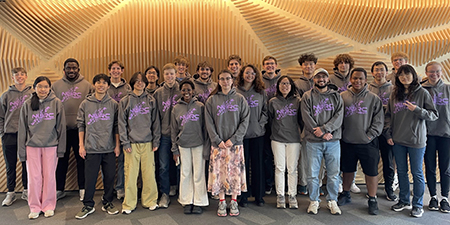
The Northwestern University Robotics Club (NURC) is an undergraduate student group dedicated to creating a community of students interested in robotics and dedicated to creating and learning together. Across our six subteams, we work on a range of projects, bringing together students across the university. We, as club leadership, intend to provide developing engineers with all the tools, resources, and guidance necessary to create robots that excite students about complex systems that do things that are fun to watch.
NURC’s combat robotics sub-team has been a long-time fixture of the club. The team works to design and manufacture competitive fighting robots similar to those popularized by the famous TV show BattleBots. Each year, we produce new robots that go on to compete in head-to-head competition against builders from across the country.
In the past year, our combat robotics team transitioned our robot development from the 30-lb. robot weight class to the 3-lb. “beetle” weight class. This change has allowed us to build more robots in a given year, giving more design ownership opportunities to a greater number of team members and allowing for more experimentation. Changing weight classes also unlocked access to a greater number of regional competitions, meaning we can take more club members to more competitions.
The combat robotics sub-team gives Northwestern students of all backgrounds and experience levels the opportunity to engage with robotics concepts in a fun and practical way. Through the process of designing, building, and competing with their own robots, members develop hands-on skills in CAD, machining, electronics, and analysis. Beyond technical growth, students also gain experience in teamwork and on-demand problem-solving brought on by the pressure of mid-tournament repairs. Competitions offer members a motivating deadline and a chance to showcase their hard work, often sparking a deeper passion for engineering. Members ultimately leave their time with the club having gained tangible accomplishments, new knowledge, and a stronger connection to the engineering community at Northwestern.
Planned Activities/Investments
Every NURC sub-team is committed to meeting twice a week throughout the year to work towards project goals and deadlines. Combat robotics typically operates on an annual design cycle. Robot concepts are formalized and pitched in the fall, designs are drafted throughout the rest of the fall and winter quarter, and robots are finally manufactured in the spring.
How this design cycle takes shape is largely up to individual team members. Each robot is developed by anywhere from 1-4 students. As an organization, we believe strongly in giving all members the opportunity to own their projects. This means that each robot team is given freedom in what they choose to make and how they choose to make it. Some teams will choose to spend longer in the design and analysis phase, and others will spend more in the manufacturing phase, depending on their interests.
Last year, we began offering new team members the opportunity to start with a kit robot that offers a basic electrical framework and drive system. This gives new members the experience of building, soldering, and testing a functional robot to gain a better understanding of how these systems work before designing and manufacturing additions such as kinetic spinners and lifters to increase their competitive performance. At the beginning of the year, three to four new members are grouped together per robot and are allowed to develop it into anything they would like. To ensure that projects remain on track to compete in the spring, milestone goals are set throughout the year by club leadership. Each team is expected to develop a robot design proposal as well as give a series of design reviews before proceeding to manufacturing. Though new members are not required to begin with a kit robot platform, we have found that nearly all prefer this as an approachable entry point. With the help of the Murphy Society, we hope to continue and expand this program into the upcoming school year.
Returning members are allowed even more freedom when it comes to developing their robots. After gaining experience working with the kit platform, returning members begin the year by forming teams and proposing a new, fully custom robot design, and typically spend more time in fall and winter quarters working in CAD and evaluating prototypes. The initial robot proposal and final design reviews are still required milestones for these robots.
Throughout this process, the club makes use of a variety of university resources. For design, team members typically use SolidWorks or OnShape CAD programs. When manufacturing, teams take full advantage of the Ford shop’s water jet, mills, lathes, and other tools. 3D printing through the Corner Makery, as well as with NURC’s printers, has also become a very important tool for the team.
Impact
This project will impact the members of NURC’s combat robotics team. Last year, the combat robotics team was made up of 12 McCormick undergraduate students, and next year we hope to expand to even more students. With the team’s current emphasis on approachability, we believe that the combat robotics program is particularly impactful for younger members who are new to robotics. Our team is focused on building engineers as much as it is focused on building competitive robots. Skill development, particularly in the areas of mechanical design, manufacturing, electronics, and analysis, is a core tenet of our team. We believe that we make a positive impact on our members and the wider Northwestern community by giving passionate engineers a space to connect and grow in ways that will benefit them in their future pursuits. Each year, we poll our members on what they feel they’ve learned in their time with the club and how we can improve. A successful year is one in which members of the club report feeling more confident in their engineering abilities and more connected to the community around them.
Deliverables
NURC’s combat robots are purpose-built for competition. Therefore, our primary deliverables are functional robots that can compete in, and ideally, win regional tournaments. Most of our competitions occur in mid to late spring quarter, after all robots have been completed. Last year, the team developed four new robots and competed in two competitions. As we continue to expand and attract new members, next year we aim to build six new robots and compete in three competitions - two in the spring and one in the fall. We expect that roughly half of these robots will be modified kit robots led by new members, and the other half will be fully custom robots created by returning members.
Sustainability
NURC works every year to obtain funding from a variety of sources to fund all of our ongoing multi-year project teams. We are very fortunate to have corporate sponsors as well as university resources, such as the McCormick Student Advisory Board, that provide the club with critical funding each year. Murphy funding is especially helpful for the sustainability of the combat robotics team this year, specifically as we seek to continue and expand our kit robot platform for new members. Delivering a positive experience to younger members of the team is a critical component of the club’s long-term sustainability. Though costly, investments in these sorts of programs will pay dividends in the future health of the club.
Previous Projects
Last year, NURC applied for Murphy Society funding to support the inaugural year of our robotic band project team. Thanks to the help of the Murphy Society, the robotic band team’s first year was very successful. The team was able to finish their robotic drummer system and put on several live performances during the spring quarter. The drummer robot performed autonomously alongside a band of human musicians at the student-led Kresgepalooza music festival and put on solo performances on Tech Plaza during the McCormick Student Advisory Board’s E-week festivities. In its current state, the system can play along to any recorded song, and the team is now in the early stages of giving it the ability to freestyle independently without a script using artificial intelligence. The drummer robot also features an animatronic head and torso that can bob back and forth, mimicking a real human drummer. Thanks to their strong start, the team has also grown over the course of the year, now with consistent participation from about a dozen undergraduate students. The project continues into next year, where the team seeks to create more robotics musicians. We could not be more grateful for the Murphy Society’s generosity and the part that they played in helping start this project.
Budget Overview
- New member robot kit program: $2,000
- This will provide funding for the purchase of five kit robot platforms (~$1,300) as well as the budget teams will use to add modifications to their robots (~$700). We expect this cost to fall as we can reuse more and more parts from previous years.
- 3 x custom “beetleweight” robots: $2,000
- Teams developing fully custom robots are typically given a budget of about $650. This goes towards all materials and electronics required for initial construction and tournament backups.
- Travel and lodging-related expenses for three competitions: $4,500
- Since competitions are such a large part of the focus in combat robotics, we aim to give all members the opportunity to attend competitions regardless of socioeconomic status.
- Miscellaneous: $500
- Tournament registration fees, testing equipment, etc.
Faculty Adviser/Department
Nick Marchuk/Mechanical Engineering