Connecting Cloud Concepts
Two MSIT students share their key takeaways from the program's new course on Cloud Computing.
Shan Wang (MSIT '26) spent seven years as a senior investment and product manager in China before starting Northwestern Engineering's Master of Science in Information Technology (MSIT) program.
She appreciated how business and technology connect, and she turned to MSIT to develop a stronger understanding of that intersection. Specifically, Shan wanted to explore how technology shapes modern industries.
That's why she was particularly excited to take MSIT's newest course on cloud computing.
"Cloud computing is the backbone of modern IT infrastructure," she said, "making it an essential skill for driving innovation, scalability, and cost-efficiency in any tech-driven industry."
The course explored different cloud models, cloud deployment, migration strategies, cost management, compliance, security best practices, and the future of cloud computing. Students gained hands-on experience with tools like Microsoft Azure while completing assignments ranging from server allocation to cost calculations.
Cloud Computing was taught by Yusuf Ozturk, a senior technology leader who currently is vice president of product and engineering at OLIMP Warehousing. He also is a member of the MSIT Industry Advisory Board.
Shan and Ying Liu (MSIT '26), who recently graduated from the part-time program and is director of technology assurance at professional services firm KPMG US, spoke about their experience with the course and the key lessons they learned.
Why did you want to take Cloud Computing?
Shan: I was looking forward to gaining hands-on experience with major platforms like Amazon Web Services (AWS) and understanding the architectural principles behind highly scalable systems.
Ying: I frequently assess software development life cycle (SDLC) processes for cloud migration and evaluate how those changes affect technology and security controls. A deeper understanding of cloud architecture, shared‑responsibility models, and current industry trends helps me perform more precise control testing and identify issues more effectively in cloud‑based environments. It also gives me clearer insight into what responsibilities fall on the cloud service provider versus the cloud customer, which is essential when evaluating whether controls are designed and operating effectively.
What were your favorite projects from the course?
Shan: My favorite part was the hands-on project where we actually deployed a scalable, fault-tolerant application. I truly appreciated how the practical labs bridged the gap between theoretical concepts and real-world engineering challenges.
Ying: My favorite project in the class was the series of hands‑on Azure assignments. Working directly in the Azure portal helped me understand how cloud resources—especially virtual machines—are created, configured, and managed. The practical exercises reinforced the concepts from class and strengthened my technical understanding of cloud environments. We also built a cloud application through step‑by‑step instruction, which made the learning experience even more engaging and showed how different Azure services work together in a real solution.
What were the most important lessons you learned?
Shan: The most important lessons I learned were the hands-on skills of provisioning, configuring, and troubleshooting actual infrastructure on platforms like Azure. I plan to leverage this practical experience to automate deployments, manage cloud environments, and build cloud-native solutions in my future career.
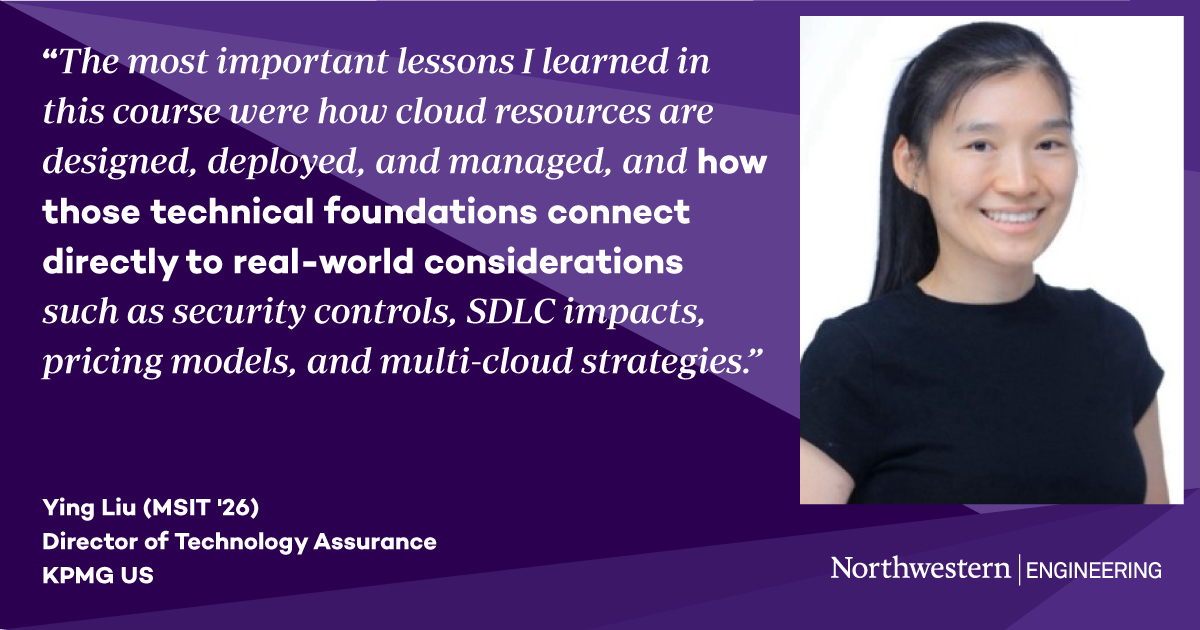
Ying: The most important lessons I learned in this course were how cloud resources are designed, deployed, and managed, and how those technical foundations connect directly to real‑world considerations such as security controls, SDLC impacts, pricing models, and multi‑cloud strategies. The hands‑on Azure work helped me internalize how cloud environments actually operate, while the broader discussions on emerging trends—like edge computing, serverless architectures, AI‑driven capabilities, and hybrid cloud growth—gave me a clearer understanding of where the industry is heading and what organizations must evaluate as they migrate to or expand in the cloud.
The course strengthened my ability to identify risks, ask more targeted questions, and provide more meaningful insights during audits involving cloud migration or cloud‑based systems.
Another important takeaway from the course was the emphasis Professor Ozturk placed on speaking up and building confidence in sharing our perspectives. Throughout the quarter, he consistently challenged us to participate more actively, and during the final class he reinforced how critical visibility and communication are in real work environments. His career advice resonated with me, and while I’ve seen the value of this in my own workplace, I can especially appreciate how impactful it is for full‑time students who may have less professional experience but are beginning to understand how essential presentation skills and visibility are for long‑term career growth.