

Renewables or Nuclear? Professor Elmer Lewis Weighs the Future of Clean Energy
Lewis examines the promises—and limitations—of competing paths to a carbon-free grid
After decades of stagnation, nuclear energy is experiencing a resurgence.
As AI drives power-hungry data centers’ rapid growth, the tech industry is increasingly looking to nuclear power plants for large amounts of reliable, carbon-free electricity. Microsoft, for example, recently signed a 20-year agreement to purchase power from a planned restart of Three Mile Island Unit 1 in Pennsylvania. Revived as the Crane Clean Energy Center, the reactor potentially could generate enough energy per year to power the equivalent of 700,000 homes.
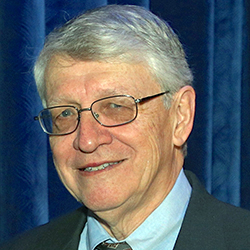
For Northwestern Engineering’s Elmer Lewis, who has studied the physics and safety of nuclear systems for more than six decades, the renewed attention marks another turn in an energy debate he has watched evolve throughout his career. As electricity demand rises and the world tries to curb greenhouse-gas emissions by shutting down fossil fuel plants, what combination of energy sources can reliably keep the US power grid running?
In his new book Renewables or Nuclear: Which Should Lead in Curbing Climate Change? (Springer, 2026), Lewis examines the technical, economic, and practical tradeoffs surrounding nuclear power, wind, solar, and hydroelectric energy. Although wind and solar power have become dramatically cheaper and more widespread, Lewis argues that their intermittency, land requirements and negative effects on grid stability will likely undercut their benefits. Nuclear energy, meanwhile, can provide steady, carbon-free power but continues to face public concerns around cost and safety.
Lewis began studying nuclear engineering during the field’s first major wave of development and joined Northwestern’s faculty in 1968. Now, with AI adding new pressure to an already stressed electrical system, he says nuclear energy is once again entering a consequential period.
Northwestern spoke with Lewis, professor emeritus of mechanical engineering at the McCormick School of Engineering, about nuclear power’s resurgence, the limits of renewable energy, and what nuclear accidents have taught engineers about reactor safety.
At the most basic level, how does a nuclear reactor generate electricity?
It starts with a neutron chain reaction. When a neutron strikes a uranium atom, it splits —a process called fission—and releases energy as heat, along with additional neutrons. Some of those neutrons split other uranium atoms, so the chain reaction keeps going.
That process produces a tremendous amount of heat. The heat from a reactor ultimately produces steam. The steam spins a turbine, which turns a generator. The generator converts the turbine’s mechanical energy into electricity, which then goes out onto the grid.
So, in that sense, a nuclear power plant isn't that different from a fossil-fuel power plant. Both use heat to produce steam and turn a turbine. The big difference is where the heat comes from. Instead of burning coal or natural gas, a nuclear plant gets its heat by splitting atoms. Importantly, nuclear plants produce millions of times as much energy per pound of fuel as fossil fuel plants do. Moreover, fossil-fuel plants emit copious amounts of the greenhouse gases that cause global warming, while reactors emit none.
Do you have an opinion on which is better: renewables or nuclear?
I think both will have a place. We already have a lot of wind farms and solar installations built or under construction, so renewables certainly will be part of the US grid. But I think the proportion of nuclear will increase. Because if we try to get a larger percentage of electricity from renewables, their limitations will become more apparent.
There are three major issues with wind and solar: intermittency, land use, and grid stability. Wind and solar are dilute energy sources, so you need a lot of land. To put the land-use issue in perspective, I did a calculation comparing wind power to two nuclear reactors that supply electricity to the Chicago area. To generate the same amount of electricity with wind, you would need a wind farm covering an area roughly the size of Cook County, which includes much of the Chicago metropolitan area.
That doesn't mean every acre would be physically occupied by turbines — land between turbines can still be used, including for agriculture. But the turbines have to be spread across a very large geographic area.
And because the best wind resources are often far from major population centers, you also need transmission lines to carry that electricity to where people use it. Much of the nation's strongest wind potential is on the Great Plains, but the transmission infrastructure needed to move all that electricity to distant cities isn't there. Building new lines can be difficult because they may need to cross multiple states, each with its own interests and approval processes.
Then there's intermittency. The sun doesn't always shine, and the wind doesn't always blow. During those lulls, other sources of electricity or stored energy must step in to meet energy demand and keep the grid stable.
Why is intermittency such a difficult problem? Can't we store renewable energy in batteries?
Batteries are valuable, but they don't solve the entire problem. In places with a lot of solar power, such as California, electricity demand remains high into the evening as solar production drops rapidly. Batteries can fill that gap for a few hours while other generating sources come online.
The bigger challenge is what is sometimes called the “dark doldrums”—periods lasting days or even weeks when skies are overcast and winds are weak. If you become highly dependent on wind and solar, you need a way to supply electricity through those extended periods.
Current large battery installations generally provide only hours of storage, not the days or weeks that would be needed in such situations. There is a lot of research into long-duration energy storage, but thus far progress has been disappointing, with no path toward a foreseeable solution.
Nuclear power still makes many people nervous. Are those safety concerns justified?
I think nuclear safety needs to be considered in the context of other risks, such as fossil-fuel air pollution, which causes thousands of deaths each year.
Chernobyl was an outlier. It was a poorly designed reactor that would not have been licensed in the West. It lacked a containment structure, and operators were conducting unauthorized experiments under circumstances that led to the accident.
Fukushima taught us a different lesson. The reactors shut down as the earthquake hit, but radioactive decay continues producing heat after a reactor shuts down. The tsunami flooded the diesel generators that powered the emergency cooling systems, so eventually the heat could no longer be removed from the reactors. Those accidents have influenced newer reactor designs.
How are today's reactors safer?
A major advance involves cooling. Older emergency cooling systems depended on pumps, valves and electricity. Newer designs can use natural convection to remove decay heat. Hot water rises and cooler water falls, creating circulation without needing electrically powered pumps. That means that even if outside electricity is lost, heat continues to be removed from the reactor.
Reactors also have improved containment structures surrounding them. In the event of an accident, those thick, reinforced barriers prevent radioactive material from escaping into the environment.
If nuclear power can provide reliable, carbon-free electricity, what's holding it back?
Part of it is public opinion, but cost has also been a major issue.
For a long period of time, the US did not build new reactors. When construction started again, projects suffered delays and major cost overruns. Part of the problem was that the workforce and supply chain that once supported reactor construction had largely disappeared. So, much of the cost problem wasn't the underlying technology; it was everything surrounding construction. Now supply chains are being reestablished and workers trained, but there's still a way to go.
Is that where small modular reactors come in?
Yes. Instead of building one enormous 1,000-megawatt reactor, you could build smaller modular reactors—perhaps 300 megawatts or less. That reduces the amount of capital you need to put up at any one time.
As important, major components can be manufactured in factories rather than constructed individually at each reactor site. If you build enough of them, reactors could become more like airplanes: You build the same design repeatedly in a factory with a trained workforce that doesn't have to move from site to site.
There are several designs being pursued now, including some that use coolants other than water and operate more efficiently at higher temperatures. We'll see which ones ultimately succeed economically.
Why does this debate feel particularly urgent right now?
First, there is climate change. Even if electricity demand stayed flat, we would still need to shut down coal and other fossil fuel plants and reduce carbon emissions.
Now, on top of that, electricity demand is increasing, particularly because of data centers. That makes the challenge harder because we need to add new electricity generation while simultaneously trying to reduce our reliance on fossil fuels. That's one reason nuclear power is getting renewed attention.
You’ve spent your career studying energy. Did anything surprise you while researching the book?
I learned a lot, particularly about hydroelectric power, which wasn't something I knew very much about. For example, some of the largest hydroelectric plants in the United States and Canada are at Niagara Falls. A substantial portion of the Niagara River doesn't actually go over the falls; it's diverted through tunnels to generate electricity.
They can divert even more water at night—after the lights on the falls are turned off—and during the winter. There's an interesting tradeoff there, too. The falls are slowly eroding, so diverting some of the water may actually help slow that erosion.
After studying both sides of the debate, what do you hope readers take away from the book?
A better understanding of the pros and cons of each.
There's a tendency to talk about individual technologies in isolation—how inexpensive solar panels have become, for example, or how much electricity a wind farm can produce. But you have to think about the entire electrical system.
The grid has to supply electricity every second of every day. It has to remain stable. It has to work when the wind isn't blowing and the sun isn't shining.
The question isn't simply whether renewable energy works or nuclear energy works. The question is what happens when you put all of these pieces together into a system that must work all the time.