

Northwestern Engineering Student Wins Overall Track First Place at HackMIT
Alan Tai helped develop an AI-powered device designed to detect counterfeit medications

A 24-hour sprint at HackMIT gave second-year Northwestern Engineering student Alan Tai and three teammates from across the country just enough time to turn an idea for detecting counterfeit medicine into a working prototype.
The final product was Peel, a device that combines optical testing with an AI-powered evidence engine to analyze how pills dissolve. The project earned the team the Overall Track first-place prize at HackMIT. Held September 19–20, the hackathon brought together more than 1,100 participants from 191 schools, 41 states, and 23 countries. Peel also took first place in Elastic’s “Find the Signal” challenge.
The result was unexpected for Tai, an industrial engineering major who recently added a secondary major in AI.
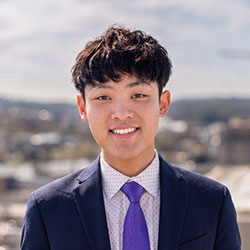
“It was a surreal experience,” Tai said. “To win the entire thing, I think that was something that I just never expected.”
Tai worked alongside Nikhil Ramlukan of Johns Hopkins University, whom he knew from previous hackathons, as well as Leo Pozhenko of Rochester Institute of Technology and Viktor Minchev of the University of California, Santa Barbara, whom he met online before the competition.
Meeting new teammates is part of what draws Tai to hackathons. He has participated in them since ninth grade, initially to learn coding while working on real projects.
“One of the things that I try to do at every single hackathon I go to is to partner with new people,” Tai said. “It’s an exciting challenge for me to have to learn new technologies and to get involved with someone that I’m unfamiliar with and to really lean in on them and trust them.”
For HackMIT, that collaboration began with a brainstorming process. The group considered more than 50 ideas, weighing their potential impact and whether they could realistically build them during the competition.
Drawing in part on Ramlukan’s background in chemical engineering and interest in medicine, the team eventually settled on Peel and the problem of counterfeit medications.
The system begins with a pill placed in water inside the tester. A magnetic stirrer dissolves the pill while an array flashes different wavelengths of light, from ultraviolet to infrared, through the solution. Sensors measure the light after it passes through the liquid, producing data that can help characterize what is in the solution.
In a second step, Peel then combines those measurements with other available information about the medication.
That step was Tai’s focus. He compiled more than 240,000 records from publicly available sources including the United States Food and Drug Administration and World Health Organization and made them searchable through the team’s system. The AI component can also draw on information such as a pill’s color and shape, its label, and pharmacy records before combining those data with the measurements from the device.
“You might also have the receipt from the pharmacy, you might also have the shape of the pill, the color of the pill,” Tai said. “All of those should be useful factors that we shouldn’t throw away in a decision.”
Tai found that lessons from his Northwestern coursework translated directly to the project.
In Applied Data Management (COMP_SCI 217), he learned about database systems, experience that helped when he needed to rapidly search the hundreds of thousands of records he had assembled. His industrial engineering coursework also helped him think about how to compare measurements and determine how closely the observed results correspond to expected ones.
“It’s a lot of that probability, statistics, and optimization that came up in this project, where the industrial engineering background was very important, even though you might not consider it at first,” Tai said.
Although the team had discussed concepts ahead of HackMIT, the members built the working prototype during the competition’s 24-hour development period. That meant adapting as problems emerged.
When the group could not obtain specific hardware at the event, they made a quick trip to a nearby store to buy parts. They also faced repeated interruptions while 3D-printing components because the printers shared electrical outlets with other electronics. And when one printed part turned out to have incorrect dimensions, the team had sandpaper and paintbrushes delivered to its hotel overnight so they could modify the piece themselves.
Despite the improvised fixes, the team completed a physical prototype that it used for demonstrations during HackMIT.
Tai said Peel could eventually have uses beyond identifying counterfeit medications, including food and drug testing.
Right now, the group is discussing how to continue developing Peel while its members attend four different universities. Among the questions are how to improve the light array and physical design and how to obtain better data for a wider range of medications.
“We know that we all want to continue development,” Tai said.