
The Problem
Laser additive manufacturing can produce advanced parts, but the resulting metal microstructures are unpredictable for complex alloys, limiting reliability for critical applications.

Laser additive manufacturing can produce advanced parts, but the resulting metal microstructures are unpredictable for complex alloys, limiting reliability for critical applications.
Use real-time X-ray measurements to reveal how atomic structure in liquid metal influences solidification and apply that insight to improve both modeling and process control in 3D printing.
By showing that atomic structure in liquid metal affects how it solidifies, this work enables better prediction and control of grain structure, leading to stronger, more reliable 3D-printed parts and wider industrial use.
Professor Tao Sun
Metal 3D printing is one step closer to smoothly building everyday technologies thanks to new research by Northwestern Engineering’s Tao Sun. The process of building objects layer by layer from digital designs, called laser additive manufacturing (LAM), promises faster and more efficient production of parts for airplanes, rockets, medical implants, and energy infrastructure. One hurdle for further adoption has been the unpredictability of microstructures, limiting LAM’s wider adoption for critical applications.

“By revealing why unusual grain structures form and how they can be controlled, this research helps remove a key barrier to using metal 3D printing in everyday technologies,” Sun said. “Understanding how metals solidify at the atomic level allows engineers to design parts that are lighter, tougher, and longer-lasting, while reducing waste, energy consumption, trial-and-error testing, and costly failures. More broadly, our study shows how cutting-edge science can potentially translate into practical improvements in manufacturing.”
When metals are made using LAM, scientists have usually assumed that how they solidify depends mainly on how fast they cool and what is the temperature gradient at liquid-solid interface. Sun’s research shows there is another important factor: how the atoms are arranged in the liquid metal before it solidifies.
Using powerful X-ray tools to observe the process in real time, the researchers found that molten metal contains different types of tiny atomic groupings. Instead of simply forming large, orderly crystals, some of these groups rearrange into small, twinned atomic structures that lead to very fine grains and unique internal boundaries in the finished metal. This helps explain why some 3D-printed metals develop unexpectedly uniform, high-quality structures.
Sun is an associate professor of mechanical engineering at the McCormick School of Engineering. He presented his work in the paper “Operando X-Ray Scattering Reveals Ordering-Mediated Solidification in Additive Manufacturing,” published in Nature Communications.
Tao SunAssociate Professor of Mechanical Engineering
Instead of assuming the molten metal is a uniform, structureless liquid, Sun demonstrated that it already contains organized atomic clusters whose short- and medium-range order influences how crystals nucleate and grow. Real-time X-ray measurements during printing provided a direct view of how these structures evolve in a melt pool, moving the field beyond post-mortem analysis and giving a more complete picture of microstructure formation.
“This insight gives researchers and engineers a new lever to design grain structure and properties in metal additive manufacturing, with implications for other rapid solidification processes as well,” Sun said.
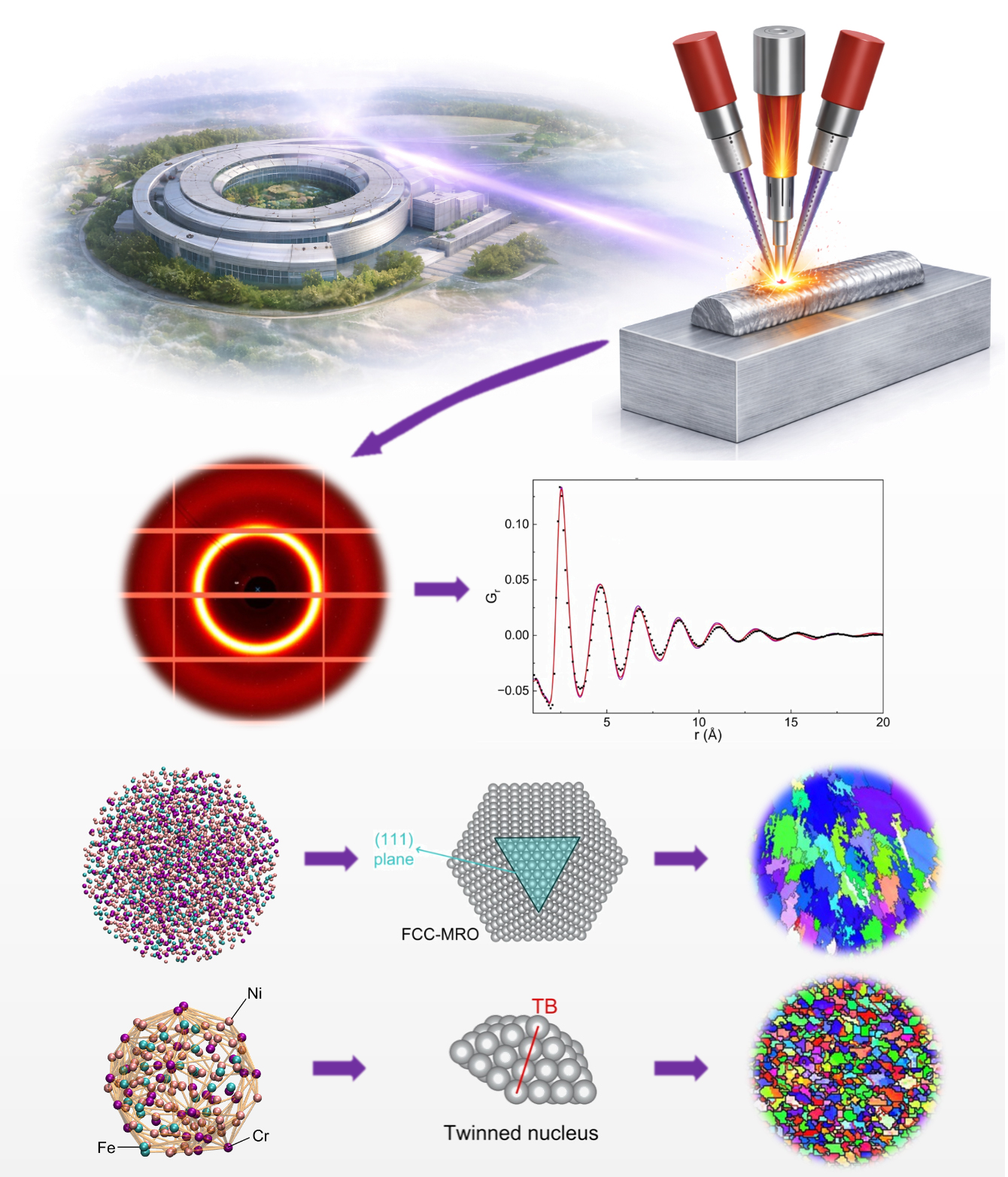
As more experiments are conducted across different alloys and processing conditions, Sun’s group aims to build a systematic database linking liquid atomic structure to final material properties. This knowledge would support two main pathways: improving predictive models that incorporate liquid atomic structure and enabling real-time monitoring and feedback control during manufacturing to steer microstructure formation.
“If realized, we can then build parts with pre-designed performance reliably,” Sun said.
Future work will focus on two main goals: better understanding X-ray data from molten metal during 3D printing and using that understanding to better control how the metal solidifies. On the analysis side, the researchers want to move away from models that assume what atomic structures are present and instead use methods that can directly rebuild the atomic arrangement from the data itself.
As a next step, Sun’s team aims to improve control over how metals change from large, column-like grains to small, evenly distributed grains by adjusting both the alloy’s composition and the printing conditions.